
This article belongs to our Herbarium — a library of what past traditions believed about the great herbs of the Work. It records history, not advice: we describe what herbalists of other centuries did and thought, and we make no claims of our own. Nothing here is a guide to use.
The warm south
Damiana is a small aromatic shrub of dry hillsides — Mexico above all, the Caribbean, the southern reaches of Texas — and its reputation is old and almost embarrassingly consistent: the peoples of old Mexico knew the leaf as a love potion, the Maya kept it in their pharmacopoeia, and the claim survives fossilized in the plant's former botanical name itself, Turnera aphrodisiaca. Few herbs have carried one idea through so many hands with so little argument. From the Maya lowlands to the drugstores of Gilded Age America to the bars of Los Cabos, nearly everyone who wrote the leaf down wrote down some version of the same thing — and the exceptions, as we shall see, are half the interest.
A portrait of the shrub
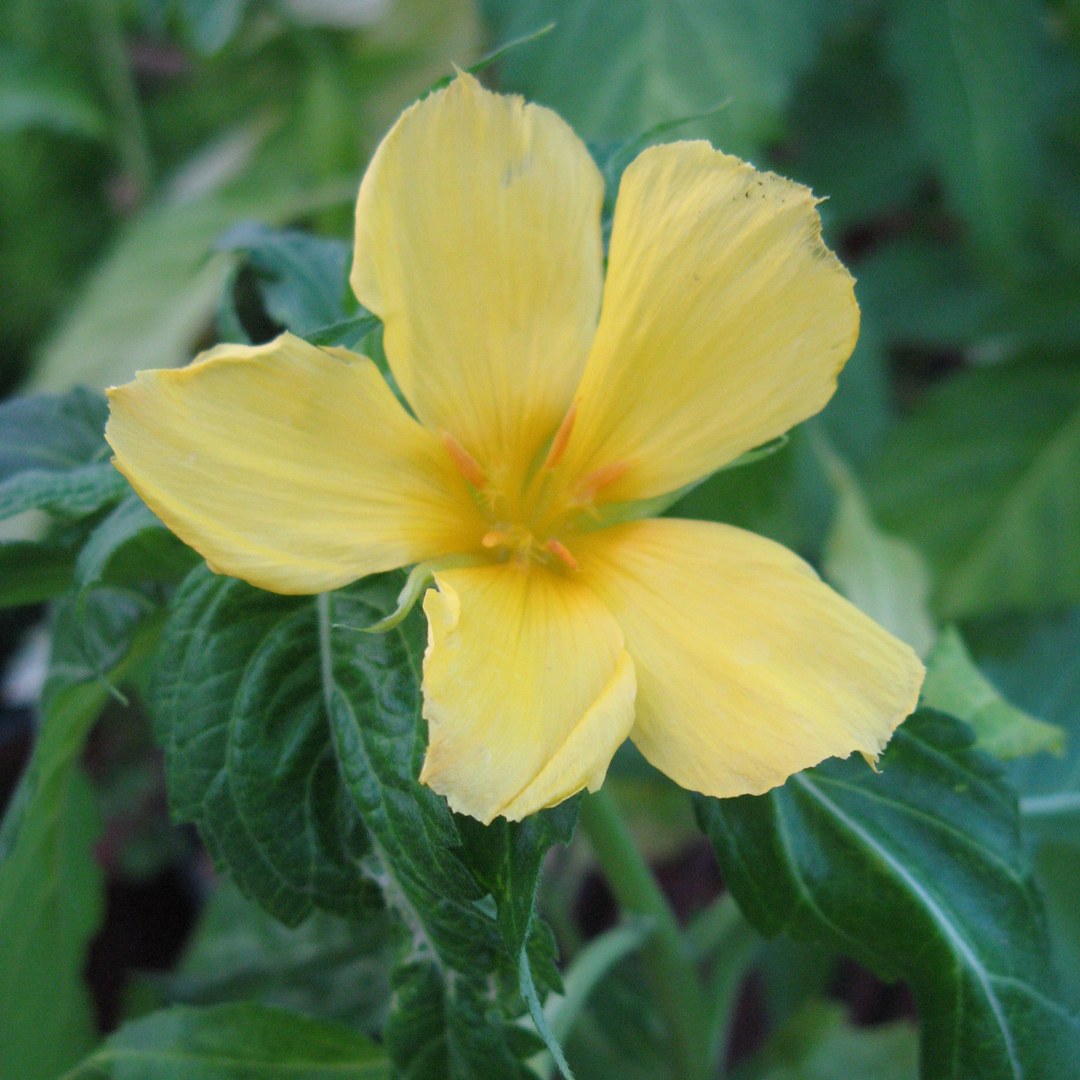
The plant itself is modest almost to the point of comedy, given the reputation. Turnera diffusa is a knee-high to shoulder-high shrub of the sun-baked slope, a cousin of the passionflowers, with small serrated leaves of a pale ribbed green and five-petaled flowers of a clear butter yellow that open after the rains. The genus name, incidentally, honors William Turner, the sixteenth-century English naturalist remembered as the father of English botany — a man who died two centuries before European science paid the shrub any real attention, and who never saw the plant that carries his name. What the eye misses, the nose finds: a crushed leaf releases a warm, spiced, resinous scent — somewhere between chamomile, fig and pine — that clings to the fingers long after the plant is out of sight. It is a plant of hard, bright, thirsty country. Where the land is rich it grows unremarkably; where the land is poor — the arroyos of Baja California, the thorn-scrub of the interior — the shrub is at home and the scent is at its strongest. The old gatherers went to the harsh hillsides for it, and the harsh hillsides never failed to provide.
The saint of the apothecaries
Even the name is a small history lesson. "Damiana" is usually traced to Saint Damian, who with his twin brother Cosmas was martyred under Diocletian and became, in the medieval imagination, the patron of physicians and apothecaries — the pair are the saints painted over pharmacy doors across the old Catholic world. That a Mexican folk herb should end up christened for the guild-saint of the pharmacists is its own comment on the traffic between mission chapel and village herb-woman: the Spanish took the plants they found, and gave them the names they had brought.
The leaf of the Maya
The written record begins, as so much of Mexican plant history does, with the Maya. Students of the Maya pharmacopoeia record the leaf among that tradition's remedies — given, interestingly, not chiefly for love but for giddiness and loss of balance — a useful reminder that a plant's most famous use is rarely its only one. The love-herb reputation is nonetheless old on that soil. A legend still told in Baja California has the Guaycura peoples of the peninsula drinking a sweetened damiana infusion in their ceremonies, with an enthusiasm said to have alarmed the mission fathers into attempts at prohibition. The story is a legend and should be enjoyed as one; but it is the kind of legend that only ever attaches itself to a plant already famous for the thing alleged.
Sixty years official
In the 1870s the leaf crossed the border into Anglo-American commerce, and it arrived the way everything arrived in the patent-medicine era: with advertising running far ahead of its evidence. The druggists' circulars of the day promoted damiana elixirs in language that would make a modern regulator faint. Yet the leaf outlasted the hucksters. In 1888 damiana entered the first National Formulary of the United States as an elixir and a fluid extract, and it remained listed until 1947 — sixty years on the official shelf of American pharmacy. The Eclectic physicians — the herbal doctors of that era — gave it a place in their dispensatories too, though with a visibly raised eyebrow: their reference works recorded the leaf's amorous reputation while observing that reputations of that particular kind tend to outrun their proof. What the Eclectics themselves prized was quieter. They gave the leaf as a gentle tonic of the nerves — for the despondent, the worn-down, and the constitution where vigour had run dry.
The herb of the low in spirit
That quieter reputation is the one Mexican folk tradition never lost. In parts of northern Mexico the plant goes by hierba del venado, the deer's herb, and the leaf remained a household presence long before and long after its American adventure: country families brewed it of an evening as a warming cordial, and the village tradition held it good for the nerves, for sadness that had settled in, and for the body whose warmth had gone out. It was believed to lift the low in spirit and warm the whole person toward joy — a leaf for rekindling, in every sense the word will bear. In the folk taxonomy that matters more than any formulary, damiana was filed not under medicine but under comfort.
Still on the table
In its homeland the leaf never left daily life, and it never needed the paperwork. In the herb stalls of Mexican markets the dried leaf is still sold in paper-wrapped bundles alongside the chamomile and the lime blossom, an everyday item asked for by name. And it flavors the traditional liqueur of Baja California — sold to this day in a bottle molded, cheerfully and unmistakably, in the shape of a woman's body, which says everything about how the region regards its herb. The bartenders of Los Cabos like to claim that the first margarita was mixed not with orange liqueur but with damiana, and whatever the historians make of that, the local custom itself is real: the damiana margarita is poured there as a point of regional pride. It is the Guaycura legend four centuries on, wearing modern clothes — the old ceremony dressed up with lime and a salted rim.
Venus in the chaparral
Hermetically, damiana belongs wholly to Venus, and few plants wear their assignment more comfortably: desire, warmth and the joy of the body — the province the leaf has occupied in every century anyone bothered to write down. The signatures line up the way the old readers of plants loved best. A soft yellow flower that opens after rain; a scent that stays hidden until the leaf is touched, and then clings; a shrub of harsh country that answers hardness with sweetness. The Renaissance doctrine that a plant's outer form declares its inner virtue would have found damiana an easy text: everything about it waits, warms, and rewards attention — which is as good a description of Venus as the tradition ever produced.
The Magical Properties of Damiana
In folk-magic tradition, damiana was a leaf of love and of vision, and the old books of correspondences filed it accordingly. Cunning-folk and later practitioners were said to carry it in a charm-bag, tuck it beneath a pillow, or add it to the incense that perfumed a working, all in the affairs of the heart. The same tradition prized it as a herb of the sight: a pinch of the dried leaf was burned before divination, the smoke thought to settle the room and open the inner eye before the cards or the scrying-glass were touched. Both uses drew on the plant's older name for warmth and gentle opening — the softening of what is guarded. None of this was reckoned medicine; it was folk charm, the leaf enlisted for the tender and the visionary, and filed always under the province of Venus.
Damiana and Xochiquetzal, the Aztec Goddess of Love
Long before the friars arrived with their calendar of saints, the peoples of central Mexico kept a goddess of love, beauty and flowers: Xochiquetzal, the "precious feather flower," patroness of lovers, weavers and the blossoming earth. Later folk tradition drew damiana into her orbit, counting the small yellow-flowered shrub among the flowering herbs such a goddess might claim as her own. The link is one of lore rather than surviving codex, and it should be enjoyed as such — yet it sits naturally on the plant. Here was a flower of the warm south, opening after the rains, gathered by the very peoples who once honoured her; and here was a goddess for whom flowers were the emblem itself. In the reckoning of later folk magic, damiana was named a flower of Xochiquetzal, burned in her memory as a token of love's tender arts.
Damiana in Love Magic and Folk Tradition
In folk-magic tradition, damiana was carried or burned for love and for vision. The dried leaf was sewn into sachets and charm-bags meant to draw affection, exchanged as a token between the fond, and scattered on the coals as an incense to sweeten a home. When the leaf crossed the Atlantic into the correspondence-books of European and American witchcraft, it kept the reputation whole: the herbals of the modern magical revival listed it plainly under love, and under the opening of dreams and the psychic sight. Its correspondences gathered the great figures of love and beauty around it — Venus of the Romans, Aphrodite of the Greeks, Freya of the North, Oshun of the Yoruba rivers. Across every one of those hands the same idea held steady: a leaf of tenderness, kept as a charm and never once as a cure.
Damiana and the Planet Venus
In the planetary scheme of the old herbalists, damiana answered wholly to Venus — the sphere of love, beauty, pleasure and gentle warmth. The correspondence was read straight off the plant: a soft butter-yellow flower opening after the rains, a scent that waited in the leaf until a touch released it, a shrub of harsh country that answered dryness with sweetness. Venusian herbs were gathered, in this reckoning, on the day and hour of Venus — a Friday, under a kindly moon, when the evening star was thought to lend her grace to the work. This was the frame the alchemists inherited when they set such a plant in glass. To follow how that virtue was drawn out and returned, see What is a spagyric tincture? — the art that separates a herb's parts and weds them again in its planetary key.
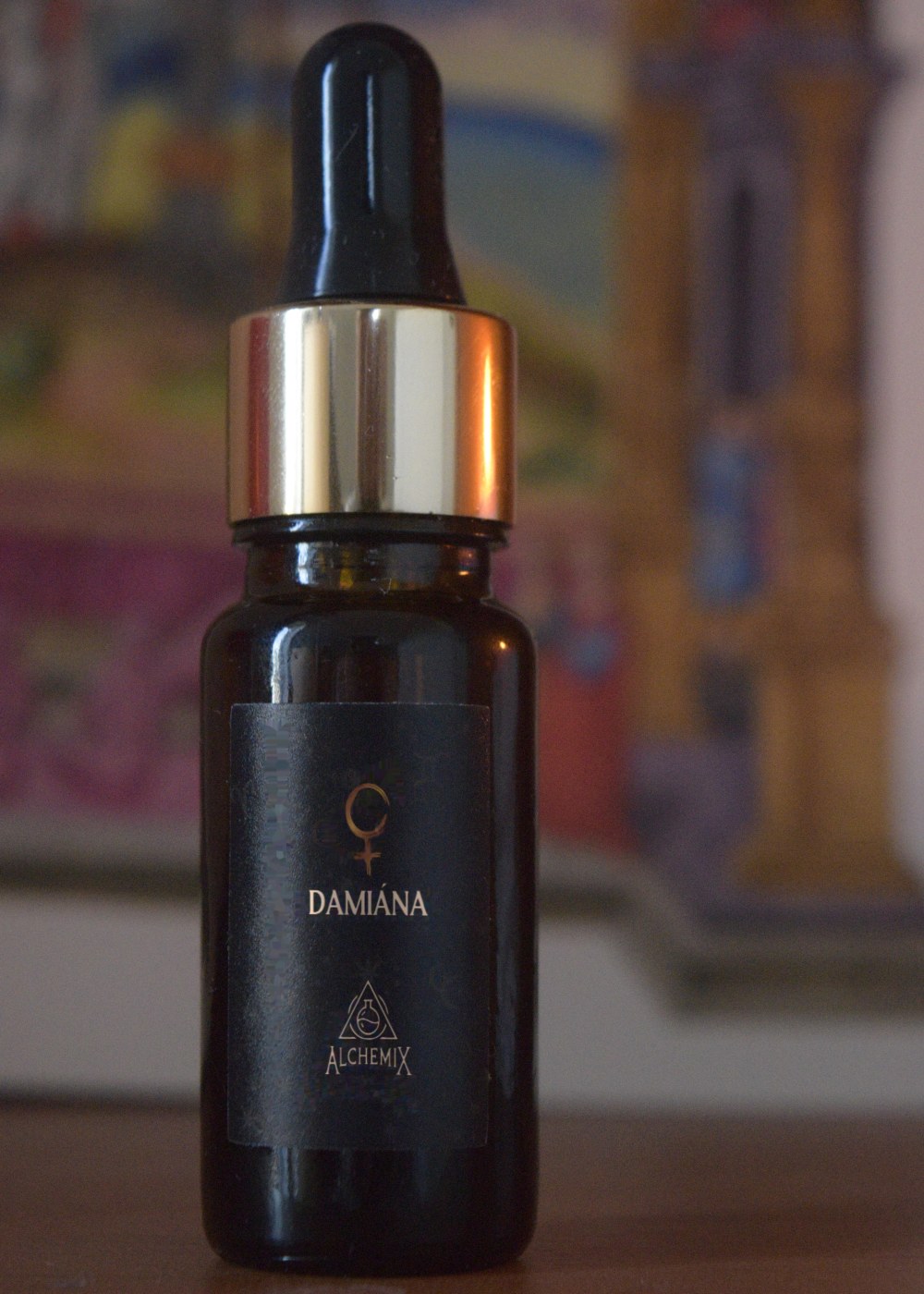
Damiana is kept in our apothecary as a spagyric tincture in the Venusian register. You can see it here. As with everything on our shelves, it is a collector's piece: the history above belongs to the traditions of old Mexico, and we sell no remedy.