
A spagyric tincture is a herbal extract prepared by the old alchemical method: the plant is separated into its essential parts, each of those parts is purified, and then they are reunited into a single, whole preparation. Where an ordinary tincture takes only what alcohol can dissolve and discards the rest, the spagyric method aims to leave nothing of the plant behind. Body, spirit and the mineral remains are all carried through into the finished work.
The word tells the whole story. Spagyric comes from two Greek verbs said to have been joined by Paracelsus in the sixteenth century: spao, "to separate," and ageiro, "to gather together." To separate and to recombine. That is the entire art in two words, and everything below is an unfolding of them.
The Three Principles: Sulphur, Mercury and Salt
To understand what is being separated and recombined, you have to meet the three principles of alchemy. These are not the substances a modern chemist means by those names; they are the three qualities the alchemists believed every living thing possessed. You can read our fuller account in On Alchemy, but in brief:
- Sulphur — the soul of the plant: its oils, its aroma, its individual character. The part that makes lavender lavender and not rosemary.
- Mercury — the spirit: the volatile, animating principle, expressed in the plant's alcohol and its subtle life.
- Salt — the body: the fixed, mineral foundation that remains when everything else has been burned away.
An ordinary alcohol tincture captures the Mercury and some of the Sulphur. It throws the Salt away with the spent herb. The spagyric art is defined by its refusal to make that discard: it reclaims the Salt, purifies it, and returns it to the whole.
The Work, Act by Act
The making of a spagyric tincture follows the same arc as the Great Work of alchemy in miniature. The stages have carried the same names for centuries.
- Extraction. The fresh or dried herb is macerated in alcohol over weeks, drawing out the Sulphur and Mercury — the soul and spirit of the plant.
- Separation. The liquid extract is drawn off and set aside. What remains is the spent plant matter, the material body.
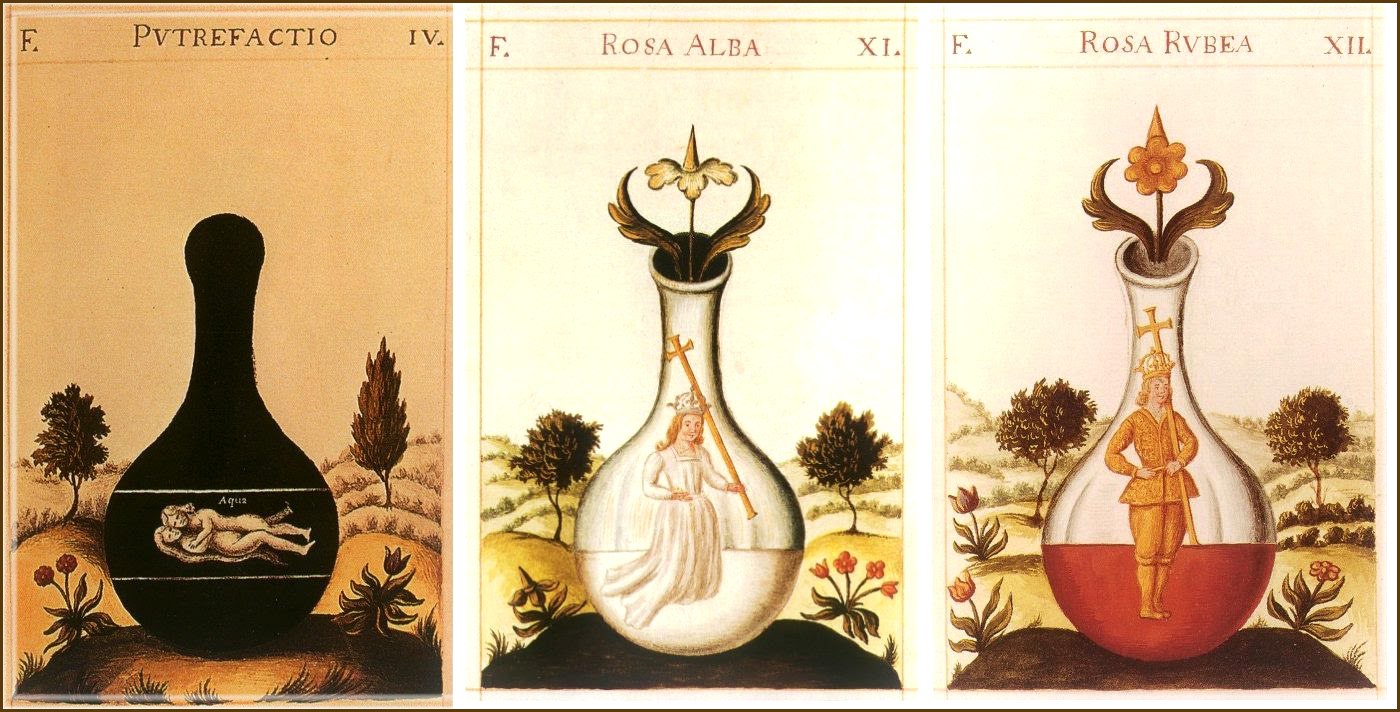
- Calcination. That plant body is burned, slowly and completely, to a fine ash. This is the nigredo, the blackening: the herb reduced to its most fixed and enduring part.
- Purification of the salts. The ash is leached and the mineral salts are drawn from it, then purified — often by repeated dissolving and crystallising — until they are clean and white.
- Cohobation — the reunion. The purified salts are returned to the reserved extract. The body is rejoined to the soul and spirit. This final gathering-together is the ageiro that gives the art its name, and it is the step an ordinary tincture never takes.
The old alchemists timed each of these acts by the planetary day and hour, working with the rhythms of the heavens rather than against them — a practice we describe in On Signatures. The result is not a stronger tincture in any measurable, modern sense, but a complete one: a preparation in which the whole plant, in all three of its principles, has been taken apart and made whole again.
How a Spagyric Tincture Differs From an Ordinary One
The difference is easy to state. A standard tincture is a single act of extraction. A spagyric tincture is a full cycle of separation and reunion that reclaims the mineral salts an ordinary tincture leaves in the discarded herb.
| Ordinary tincture | Spagyric tincture | |
|---|---|---|
| Method | One extraction in alcohol | Separation, calcination, purification, reunion |
| The plant body (Salt) | Discarded with the spent herb | Burned to ash, purified, returned |
| Principles present | Sulphur and Mercury | Sulphur, Mercury and Salt |
| Philosophy | A useful extract | The whole plant, taken apart and made whole |
Paracelsus and the Lineage
Though the practice is older, it is Paracelsus (1493–1541), the Swiss physician and alchemist, whose name is bound to the word. He set the separation of the three principles at the centre of his art and is generally credited with coining spagyria itself. After him the tradition passed through the seventeenth-century alchemists and, much later, was gathered and systematised in the twentieth century by figures such as Alexander von Bernus and the alchemist who wrote under the name Frater Albertus, whose Alchemist's Handbook taught the plant work to a modern generation. It is that living lineage — not a modern invention dressed in old language — that the spagyric method belongs to.
The Seven Planetary Signatures
In the hermetic view, every plant stands under the rulership of one of the seven classical planets, and that planet is its signature: the key to its character and the pattern the alchemist works with. The doctrine of signatures — the idea that a plant announces its nature through its form, habit and virtues — is the subject of its own essay, On Signatures.
Each tincture in our Apothecary is made under, and named for, its planetary signature. Here is the whole collection, arranged by the seven planets:
| Planet | The Tincture | Botanical name | Its story |
|---|---|---|---|
| ♄ Saturn | Pine | Pinus sylvestris | The winter tree |
| ♄ Saturn | Mullein | Verbascum thapsus | The torch plant |
| ♄ Saturn | Cuti Cuti | Argyrochosma nivea | Fern of the Andes |
| ♃ Jupiter | Lemon Balm | Melissa officinalis | Melissa's history |
| ♃ Jupiter | Clove | Syzygium aromaticum | The spice worth gold |
| ♂ Mars | Hawthorn | Crataegus monogyna | Tree of the heart |
| ♂ Mars | Basil | Ocimum basilicum | The royal herb |
| ♂ Mars | Guarana | Paullinia cupana | The Sateré-Mawé legend |
| ♂ Mars | Tribulus | Tribulus terrestris | Caltrop vine, gokshura |
| ☉ Sun | Eyebright | Euphrasia officinalis | Herb of sight |
| ☉ Sun | Angelica | Angelica archangelica | The archangel's root |
| ♀ Venus | Damiana | Turnera diffusa | Love leaf of Mexico |
| ♀ Venus | Lady's Mantle | Alchemilla vulgaris | The little alchemist |
| ♀ Venus | Manayupa | Desmodium adscendens | Herb of countless uses |
| ☿ Mercury | Lavender | Lavandula angustifolia | History and folklore |
| ☿ Mercury | Gotu Kola with Brahmi | Centella asiatica + Bacopa monnieri | The scholar's herbs |
| ☿ Mercury | Marjoram | Origanum majorana | Joy of the mountain |
| ☽ Moon | Ashwagandha | Withania somnifera | The stallion's root |
Why We Offer Them as Collector's and Study Artefacts
A word on how these tinctures are presented, because it is deliberate and it matters.
Each Alchemix tincture is prepared as a faithful reconstruction of a historical spagyric recipe and offered as a collector's and study artefact — an object for the shelf, the cabinet and the contemplation of the art, not a food, a medicine or a cosmetic. We make no claim that any of them treats, prevents or affects any condition, and we describe the plants only as tradition, folklore and the hermetic writers themselves described them. What you will find in these pages is history and correspondence: what the alchemists believed, what the old herbals recorded, and how the Work was done. What you will not find is a health claim, because that is not what these objects are for.
This is the honest frame for anyone drawn to alchemy as a living tradition rather than a shelf of supplements: the value here is the craft, the lineage and the meaning, held in glass.
Where to Begin
If this is your first meeting with the art, begin with the philosophy in On Alchemy, then the doctrine of signatures in On Signatures, and the role of the purified mineral body in On the Alchemical Salt. When you are ready to see the Work made into objects, the whole collection waits in the Apothecary, each tincture under its planet, each with its own story to tell.
To separate, and to gather together. That is the whole of it — and it is a great deal.