
This article belongs to our Herbarium — a library of what past traditions believed about the great herbs of the Work. It records history, not advice: we describe what herbalists of other centuries did and thought, and we make no claims of our own. Nothing here is a guide to use.
The dew of heaven
No plant in the European garden is more literally alchemical than this one — the name Alchemilla, the little alchemist, is the receipt. Each pleated, fan-shaped leaf gathers the night's moisture toward its center, where it stands as a single flawless drop, silvered and trembling, refusing to wet the leaf that holds it. Much of that water the plant exudes herself, pressing it out through the margins of her own leaf in the small hours — a detail the old adepts could not have described as the botanists later would, but one they would have savored beyond measure: the purest water in the garden not fallen, but offered.
The alchemists collected that drop as ros coelestis — celestial dew, the tenderest of waters, believed to carry the virtue of the heavens down into the vessel — and prized it for the operations of the Great Work. Dew, in the alchemical cosmos, was heaven's daily gift to the earth, delivered at the meeting of night and morning; a plant that concentrated it into one perfect bead was not a weed but an instrument.
The name on the label
The sixteenth-century botanists who fixed the Latin name knew exactly what they were saying: Alchemilla, the alchemist's own herb — and some older writers traced the word further back still, through the Arabic term from which the word alchemy itself descends. The folk names are just as good a portrait, each one a different glance at the same leaf. Dewcup, for the obvious reason. Lion's foot — pied-de-lion in French — for the broad, lobed print of the leaf. Nine hooks, counting the toothed lobes. Bear's foot, in some counties. In Germany she is Frauenmantel, the lady's cloak; but an older German name, Sinau, is glossed by the etymologists as "ever-dew" — the plant that is never without her drop. In Norway she is marikåpe, Mary's cloak. Half of Europe named the leaf; the other half named the water standing on it.
Gathered before sunrise
Dew-gathering was real work, not merely an image. The Mutus Liber — the famous "wordless book" of alchemy, published at La Rochelle in 1677 and told entirely in engravings — devotes early plates to a man and a woman wringing dew from cloths they have stretched overnight across a field: the harvest of heaven twisted into basins before the sun can take it back. The adepts held the dew of May to be the most potent of all, charged by the season of growth. Some of the alchemical writers went further, holding that dew was charged with a celestial spirit — the fertilizing breath of the heavens, condensed and made liquid — so that to gather it was to bottle a fragment of the sky. Country custom agreed, in its own register: on May mornings girls went out before sunrise to wash their faces in the dew — from the grass generally, and, where she grew, from the flawless drop of the lady's mantle in particular — for it was believed to give a beauty that lasted the year. High alchemy and village folklore, drawing from the same leaf: one called it the water of the philosophers, the other the water of a fair face, and both rose before dawn to get it.
Our Lady's cloak
The medieval eye saw something else in the pleated leaf: a folded cloak, and it dedicated the plant to the Virgin. Frauenmantel, Our Lady's mantle, Mary's cloak — the dedication repeats across the languages of northern Europe, and under that patronage the plant took her place in the monastery physic gardens and, more intimately, in the practice of the herbwives and midwives. She became the woman's herb of the old tradition: it was believed she eased the woman's seasons and steadied their tides, mended what sorrow had worn thin, and kept — like the cloak she was named for — the household of women. What the old herbals meant by all this they said in their own veiled language, and the veil was part of the meaning: a plant of protection, of things gathered in and held.
Seed without a father
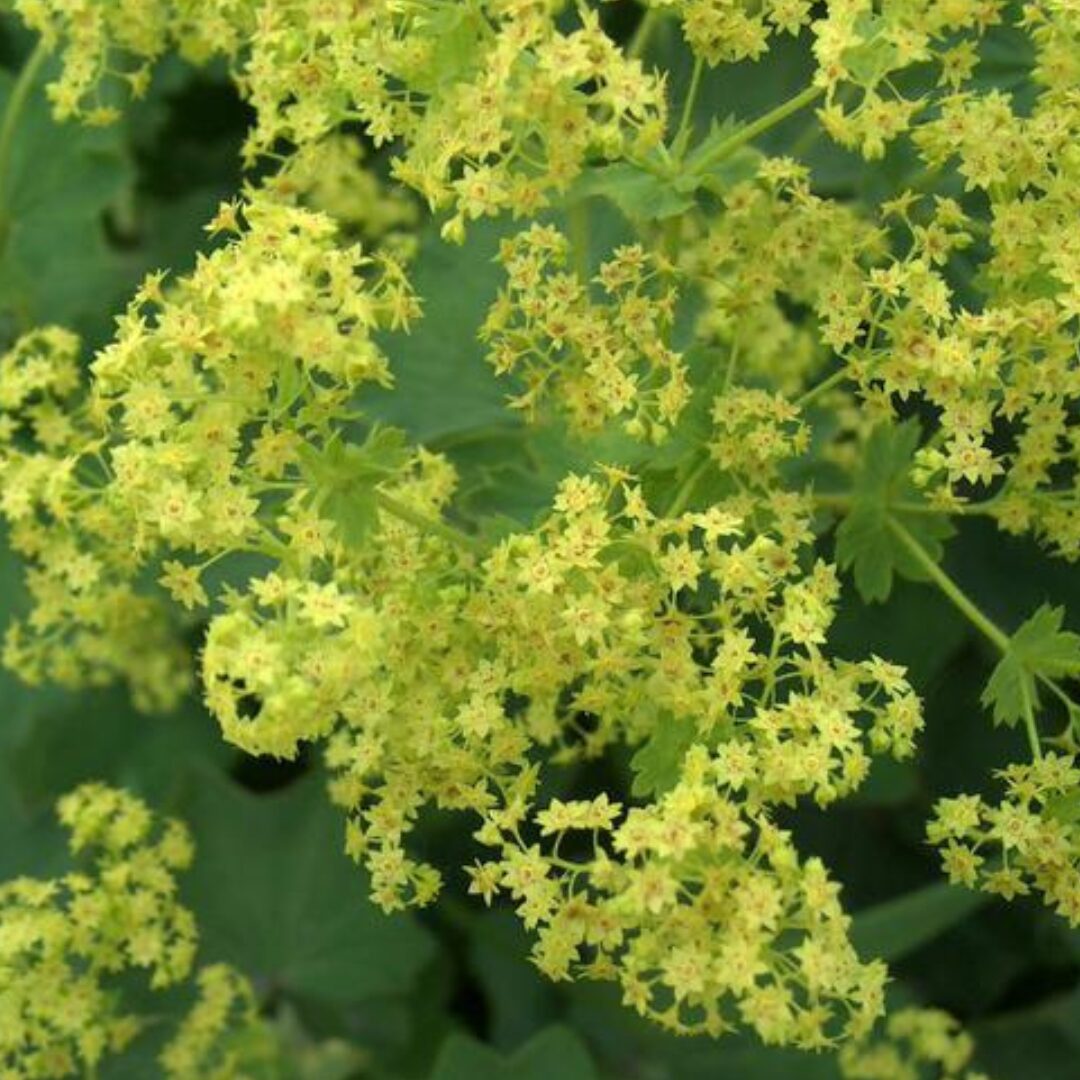
Her botany, read closely, is stranger and more fitting than the medieval namers could have known. Lady's mantle belongs to the rose family, yet she has renounced everything the rose is famous for: her flowers are tiny, green-gold, and carry no petals at all — a foam of quiet stars in early summer, where her cousins blaze. Stranger still, those flowers set seed without any fertilization; the seed is the mother's alone, and each of her countless local forms breeds perfectly true, generation after generation, so that what the books call Alchemilla vulgaris is really a crowd of nearly identical sisters. The botanists worked this out long centuries after the plant had been dedicated to the Virgin — the naming came first, and the vindication, of a poetic kind at least, came after. It is the sort of joke the garden plays very rarely.
She has a mountain sister, too. On the high screes and summits of Scotland and the Alps grows Alchemilla alpina, a smaller and more finely made plant whose leaves are divided into slender fingers, green above and clothed beneath in a silk so bright it looks like polished silver. Where the lowland plant offers a drop of water, the alpine one offers a mirror — and the mountain people, who named most things well, simply called her by the same cloak-names as her larger sister, silver lining included.
What the herbals said
Nicholas Culpeper, writing in the 1650s, claimed her for Venus without ceremony, and counted her among the great wound-herbs of the tradition — a plant for binding, closing and making whole, in his reckoning, which is the cloak's work translated into the field-surgeon's register. The esteem was general: the herbals of the sixteenth and seventeenth centuries kept her in the standing repertory, and the alpine countries — where she grows most luxuriantly, along cold streams and in high meadows — held her in a particular affection that their folk names record to this day.
Venus in the garden
Culpeper's planetary assignment has never moved: the hermetic tradition keeps her under Venus, but Venus in her caretaking register — not the passion of the myrtle or the rose, but the daily devotion of the folded cloak and the gathered drop. Her signature is care itself: the one who collects the purest thing each night, holds it out uncomplaining every morning, and asks for no attention while doing it. In a tradition that loved emblems, the little alchemist is one of the most complete — the whole art of patient distillation performed silently, on a green bench, every night of the summer.
The Magical Properties of Lady's Mantle
The magical properties folk tradition ascribed to lady's mantle all gathered, in the end, around her one perfect drop. In the villages of Eastern Europe the leaves were said to be hung about the doorway or burned upon the hearth to turn back storms and drive off ill-wishing spirits — a plant of household protection, the cloak-name made into a charm. The dew itself carried the greater reputation. It was believed to be a water of the sacred feminine, gathered before dawn to restore a fair face and to draw the favour of the goddesses of womanhood. None of this was ever a prescription; it was the old poetry of a leaf that seemed to make something precious out of the night, and the country people, watching that drop stand flawless at first light, decided the plant must be an instrument of quiet power.
Alchemilla: Why Alchemists Called Her the Little Alchemist
The name itself is the proof of her standing. Alchemilla — the little alchemist — was traced by the old writers back through the Arabic al-kimiya, the very word from which alchemy descends, so that to speak her name was to name the Art in miniature. The reason was the dew. The adepts held the flawless drop she pressed from her own leaf to be a pure "water from heaven," a celestial water untouched by the ground, and they numbered it among the substances they sought for the operations of the Great Work — some linking it, in their veiled way, to the making of the Philosopher's Stone. She was, in the alchemical reading, a small green vessel performing distillation on her own, every night, without fire. To follow how such a plant became a spagyric matter at all, see What is a spagyric tincture?.
The Celestial Dew and the Sacred Feminine
The dew of lady's mantle sat at the crossing of two traditions, and both rose before the sun to gather it. To the alchemists it was ros coelestis, the celestial water charged with the virtue of the heavens. To the folk it was something tenderer: the dew collected on Beltane and the May mornings was believed to restore beauty and to keep the year's freshness in a woman's face, and where she grew, girls were said to seek her single drop above all the grass around her. Under the cloak-names — Our Lady's mantle, Mary's cloak — the plant was long tied to the sacred feminine, a herb of the goddesses and of things gathered in and protected. The old belief made her dew a heavenly gift lent, for one bright hour, to the earth.
Lady's Mantle and the Planet Venus
In the house's hermetic reckoning, as in Culpeper's, lady's mantle answers to Venus — and to the Moon that governs dew and the tides of the night. But hers was always Venus in the caretaking key rather than the amorous one: the planet read not as desire but as devotion, the gathering-in, the quiet keeping. The tradition attuned her equally to the goddesses of womanhood, so that her signature became the sacred feminine at its most patient — the one who collects the purest thing each night and offers it without asking to be seen. Venus, the Moon, and the folded green cloak: a threefold signature of care, secrecy, and the flawless drop held out at dawn. No plant in the garden wore the Venusian mark more gently, or more completely.
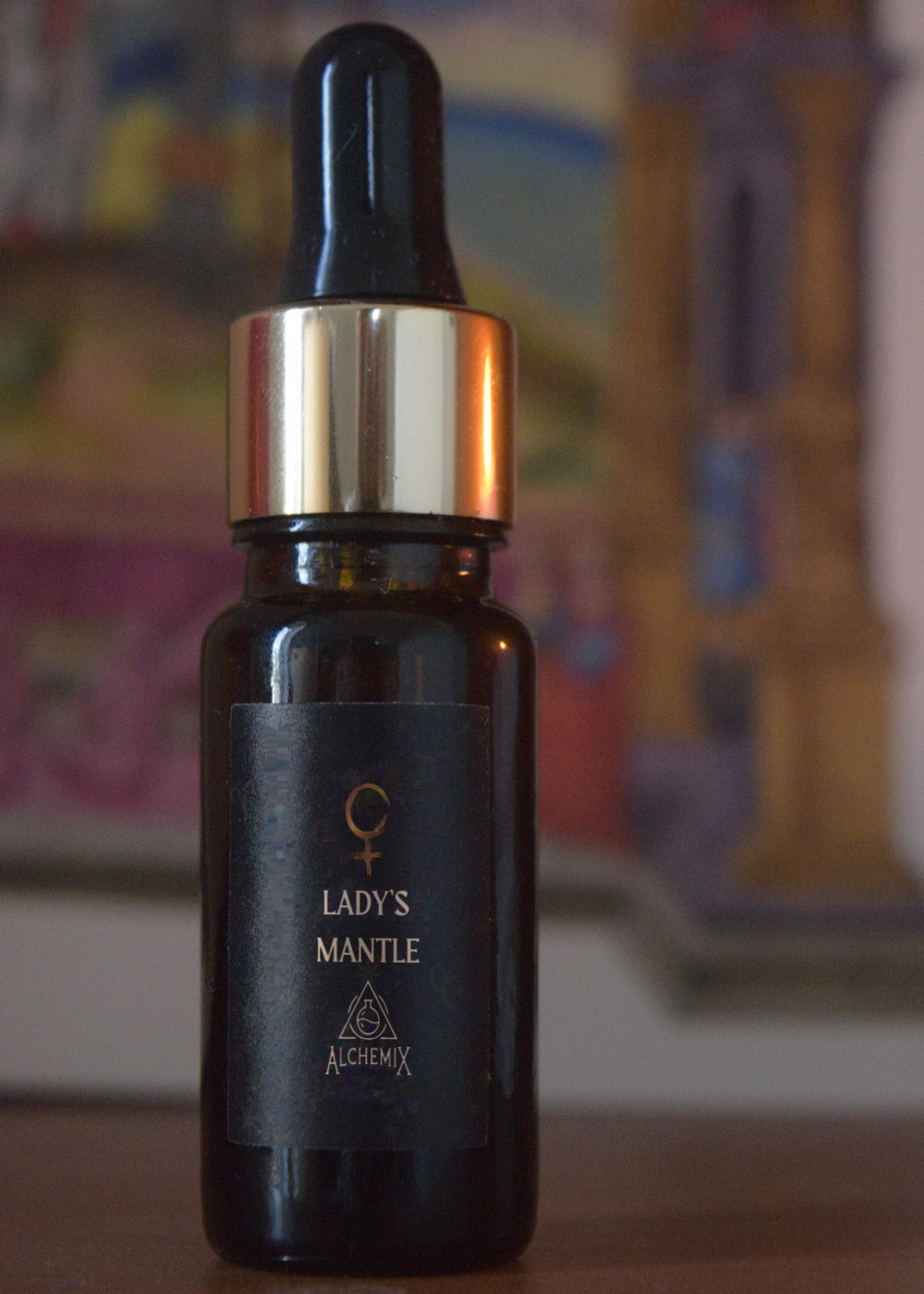
Lady's Mantle is kept in our apothecary as a spagyric tincture in the Venusian register — the most alchemical name in the whole garden, on our own shelf. You can see it here. As with everything on our shelves, it is a collector's piece: the history above belongs to the adepts and herbwives of the past, and we sell no remedy.