
This article belongs to our Herbarium — a library of what past traditions believed about the great herbs of the Work. It records history, not advice: we describe what herbalists of other centuries did and thought, and we make no claims of our own. Nothing here is a guide to use.
The fruit that stares
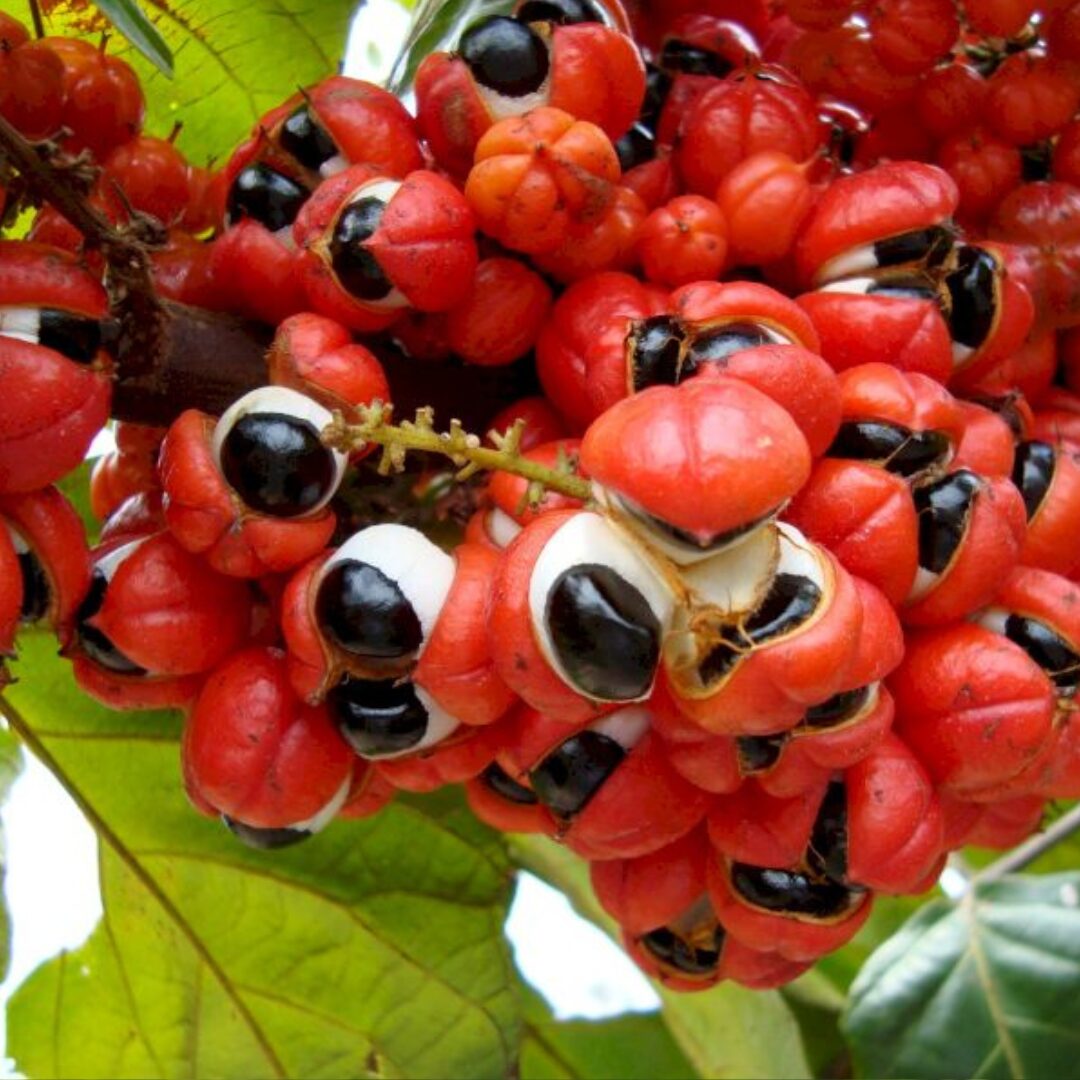
When the red fruit of the guarana vine ripens and splits, a black seed emerges from a white aril — and the whole thing looks, unmistakably and a little unnervingly, like an eye opening. The Sateré-Mawé people of the Brazilian Amazon, guarana's first cultivators and still its greatest masters, tell the story of why. A child of the people, beautiful and beloved, was slain out of jealousy — in the tellings, by a spiteful divinity who could not bear how the community cherished him. His grieving mother buried him, and was told to plant his eyes in the cleared earth. From the left eye grew a wild and useless plant; from the right grew the first true guarana, and from that vine the Sateré-Mawé were born as a people. The plant is a memorial that bears fruit: the buried gaze that stayed among the living to watch over them. To this day the split fruit, with its dark pupil ringed in white, keeps the legend legible on the branch.
The vine itself
Guarana is Paullinia cupana, a woody climbing liana of the soapberry family, native to the Amazon basin and most at home in the humid lowland forests of the Rio Negro and the Maués region of Brazil. Left to itself in the wild it scrambles high into the canopy on the shoulders of larger trees; under cultivation the Sateré-Mawé keep it low and bushy so the clustered fruit can be reached by hand. The flowers are small and pale; the fruit ripens to a bright scarlet-orange capsule that opens on its own when mature. Inside sits the prize — a single glossy seed, dark as jet, half-clothed in a white fleshy aril, the arrangement that gives the fruit its watching eye. The seed is unusually rich in the bitter compound that gives coffee and tea their savor; older writers even called that compound "guaranine" before chemistry recognized it as the same caffeine found in the coffee bean, and by weight the guarana seed carries a good deal more of it than coffee does. That plain fact of botany sits behind everything the tradition came to believe about the plant.
The word itself
The name we use is the plant's own. "Guaraná" comes, by way of Portuguese, from the Sateré-Mawé word for the vine — rendered by outsiders as warana — and the people's own gloss ties it back to the founding legend: the fruit likened to the eyes of the people, the seed that watches. From the tongue of the Maués river it passed into Portuguese, and from Portuguese into the botanical and commercial vocabularies of the whole world, so that the soft-drink label on a shelf in another hemisphere still carries, worn smooth by travel, a word first spoken for a buried child's returning gaze. Few plants keep the name their first cultivators gave them so nearly intact.
The people of the guarana
The Sateré-Mawé call themselves, in effect, the people of the guarana, and their claim to the plant is not merely poetic — they are its domesticators. It was they who took the wild forest liana and, over unrecorded generations, bred and tended it into a cultivated crop, propagating chosen vines and clearing the forest gardens where it would grow within reach. Guarana sat at the center of their social and ceremonial life: a substance of hospitality, of council, of the long night's talk, prepared and shared according to custom rather than taken casually. The plant belonged to the community the way the founding legend said it should — as a gift left behind by one of their own.
The making of the paste
The preparation the Sateré-Mawé developed is a small masterpiece of forest craft. The ripe seeds were shelled, washed, and roasted, then ground — traditionally in a stone mortar or by hand — into a dark dough. This paste was worked, sometimes with a little water or cassava flour, into cylindrical bars or loaves and dried slowly over smoke until they hardened into something like a dense, dark bread that would keep for a very long time in the damp of the forest. The hardened bars were a kind of forest currency of effort: portable, near-imperishable, and holding the whole virtue of a harvest in a form that could be carried into the deep forest or down a river for weeks. From these bars a portion was rasped as needed into water, and the rasp itself was traditional: the rough, file-like tongue-bone of the pirarucu, the giant fish of the Amazon rivers, drawn across the bar to shave off a fine powder. Custom governed the sharing of the drink as much as the making of it — it was passed and taken by turns, an act of hospitality and of gathering rather than a thing swallowed alone. The result was a bitter, stimulating draught and a preparation that traveled and stored — no small thing in a climate that spoils most foods within days. Seventeenth-century Jesuit missionaries who ventured up the rivers recorded the esteem the drink commanded among the peoples who made it, describing a substance they did not fully understand but could see was held in unusual regard.
What the forest believed of it
The reputation attached to the seed was one of wakefulness and endurance. It was believed to banish weariness, to sharpen the hunter's watch through the long dark of a forest night, and to give staying-power for the punishing distances of travel by foot and by canoe. In the old accounts the drink was the companion of effort — reached for before the hunt, before the journey, before the labor that could not be interrupted. The missionaries who first described it noted this reputation with the mixture of suspicion and interest that the period reserved for the customs of the peoples they met; but they recorded, at least, that the esteem was real and old. What later chemistry would identify plainly as one of the most caffeine-rich seeds in the world, the forest had already sorted, by long observation, into the category of things that keep a watcher awake.
Out of the forest
When the seed reached the wider world in the nineteenth century, it did not stay a sacred bar rasped on a fish-bone. European and Brazilian pharmacy took an interest in the "guaraná" of the Amazon, and the powder entered the pharmacopoeias of the age as a curiosity of the New World. Its more lasting career, though, was Brazilian and popular: by the late nineteenth and early twentieth centuries the guarana seed had become the flavoring soul of a national soft drink, and the bright, faintly bitter guaraná soda remains to this day one of the most Brazilian tastes there is — a sacred forest preparation carried, by a strange and complete journey, into the ordinary bottle on the shop shelf. Through all of it the Sateré-Mawé have kept their older relationship with the vine, and their cultivation of it, intact.
The Legend of Guarana: The Children of the Sateré-Mawé
The Sateré-Mawé of the Maués river tell that they are, in the plainest sense, the children of the guaraná. In their telling a boy was born to the people as a gift of Tupã, the great sky-god — a child so bright and so beloved that the whole community cherished him. The story that grew around him is a story of origin: from his burial came the first vine, and from that vine the people themselves were said to descend. To be a child of guaraná was no metaphor to them but a genealogy, the founding fact of who they were. Down the generations they kept the tale as they kept the plant — carefully, and as their own — so that the legend and the cultivation reached the wider world together, each inseparable from the other.
Jurupari's Envy and the Buried Eye
Into that brightness the darkness came as envy. The tellings name Jurupari, the spirit of night and shadow, who could not bear how the people loved the child and moved against him in the form of a serpent, and the boy was slain. His grieving mother was counselled to plant his eyes in the cleared earth. From the left eye rose a wild and useless plant; from the right rose the first true guaraná, and its fruit carried the shape of what was buried — a black seed set in white, a pupil ringed in an open lid. So the legend made the plant a memorial that could still see: the beloved gaze put into the ground and given back as a vine that watched over the people who had lost him. The buried eye stayed, in the story, among the living.
Wara'ná: The Fruit That Looks Back
The name keeps the legend spoken. From the Sateré-Mawé tongue the word passed, as wara'ná, into Portuguese and from Portuguese into the vocabularies of the whole world, worn smooth by travel but never quite losing its first meaning — glossed by the people themselves as the eyes of the people, the fruit that looks back. The likeness is no strain of the imagination: when the ripe red capsule splits it shows a dark seed half-clothed in a white aril, and the resemblance to an eye opening is immediate and a little uncanny. Etymology and appearance answer each other exactly. Few plants have carried the name their first cultivators gave them so nearly intact, or worn on the branch so legible a proof of the story behind the word.
Guarana as the Origin of Wisdom in Amazonian Myth
For the Sateré-Mawé the vine was more than a founding ancestor; it was held to be the very origin of wisdom and knowledge among the people. In the old understanding the plant left behind by the buried child carried something of him into the life of the community — the presence around which counsel gathered and the long night's talk was held, according to custom. What the alchemists of Europe reached for when they made a spagyric tincture — the separated and re-joined virtue of a plant, its pattern kept whole — the forest tradition told in its own idiom, as a gift of understanding handed down in a growing thing. Myth and cultivation were one teaching: that wisdom, like the vine, is something planted, tended, and inherited.
The unsleeping watch
Nature rarely writes a signature this legible: a seed shaped like an open eye, esteemed across centuries for keeping the watcher awake. In the hermetic reading the plant falls under Mars — the register of vigilance, readiness, the sentry's virtue, the alertness that does not slacken while others sleep. The signature is the eye that never closes: the buried gaze of the legend still doing, in story, exactly what the living tradition believed the roasted seed did for the hunter on his long night. Memorial and stimulant, the watching fruit and the wakeful drink, are one image seen twice.
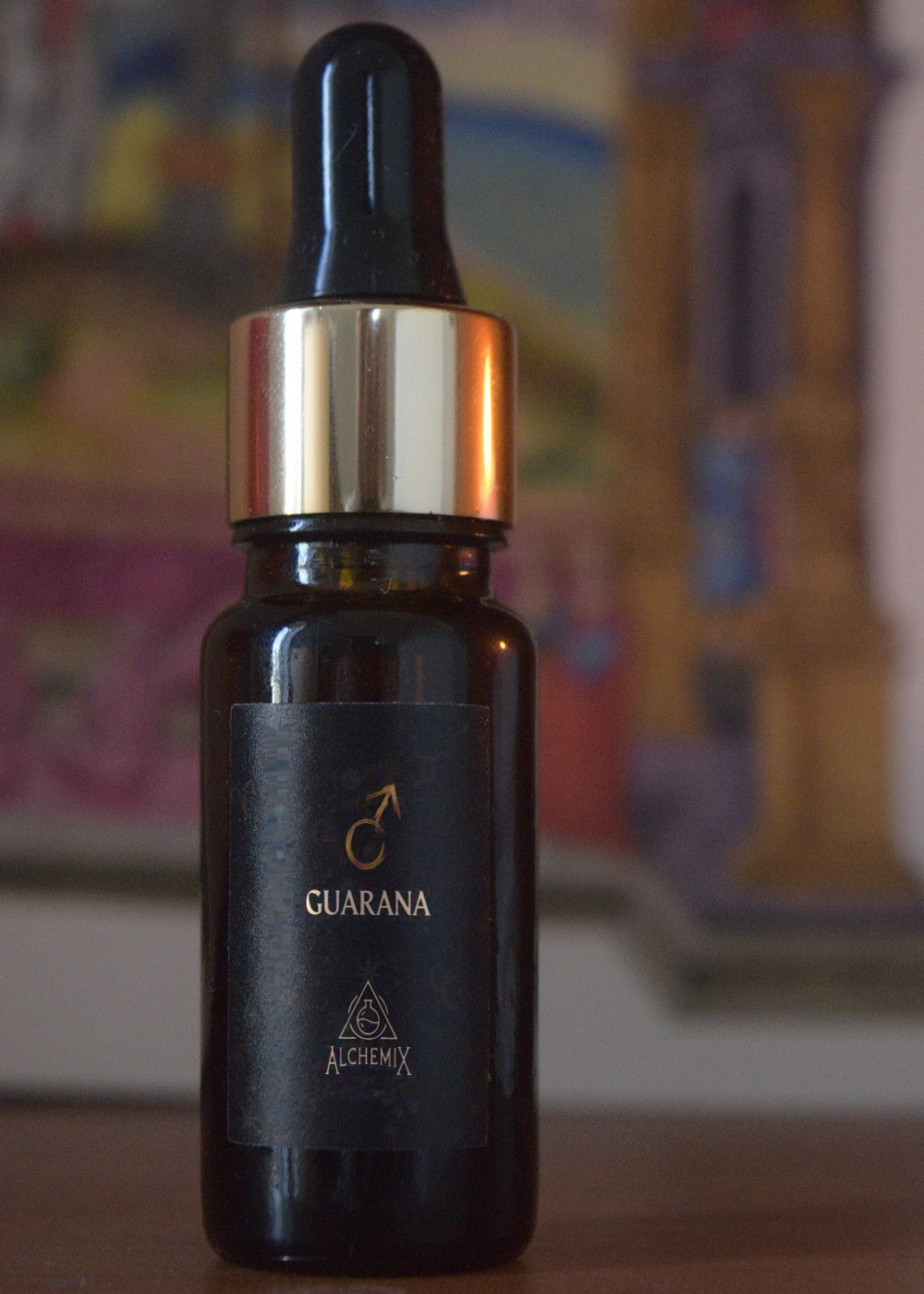
Guarana is kept in our apothecary as a spagyric tincture in the Martial register. You can see it here. As with everything on our shelves, it is a collector's piece: the history above belongs to the peoples of the Amazon, and we sell no remedy.