
This article belongs to our Herbarium — a library of what past traditions believed about the great herbs of the Work. It records history, not advice: we describe what herbalists of other centuries did and thought, and we make no claims of our own. Nothing here is a guide to use.
Euphrosyne's flower
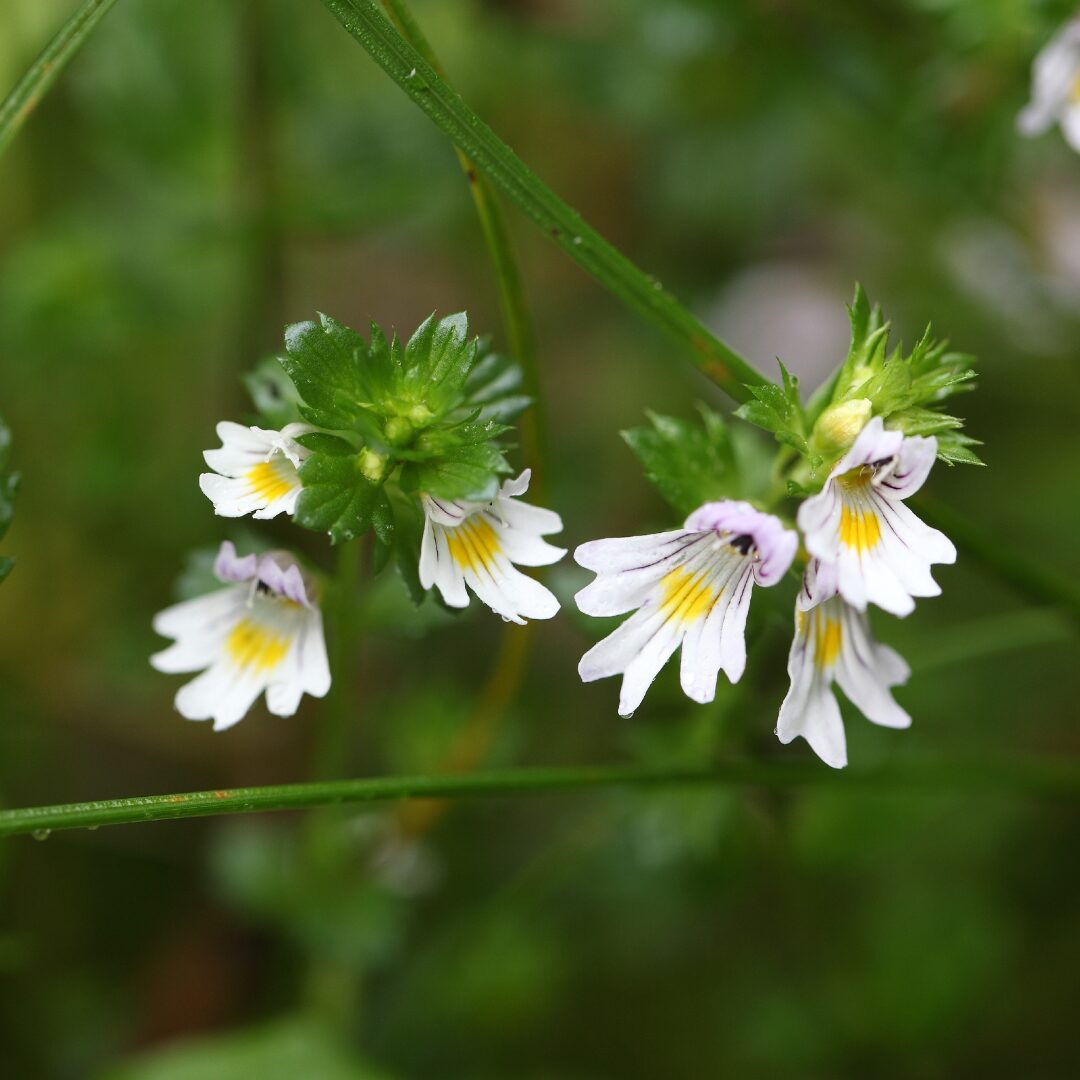
Euphrasia is named for Euphrosyne, one of the three Graces of Greek myth — the grace of gladness and good cheer. It is a strange name for a plant so small: eyebright is a modest herb of meadows and heaths, ankle-high at best and easily missed among the grasses. But its flower is not modest at all. Look closely and it is painted: a white face, a golden eye at the centre, and fine violet veins raying outward like lashes.
An old story explains the name with a bird. The linnet, so the legend runs, was the first to discover the plant, using its leaf to clear the sight of its young — and the linnet's Greek name and the herb's, the storytellers held, were one and the same. Like most etymological legends it is better poetry than philology, but it shows how completely the plant and the idea of clear sight had fused in the folk imagination: even the naming had to be about seeing.
What eyebright is
Botanically, eyebright leads a double life. It is green and it flowers, but it is a hemiparasite: below ground, its roots fasten onto the roots of neighbouring grasses and draw part of their living from them. It thrives in old meadows, chalk downs, and close-cropped upland turf, blooming from midsummer into autumn — precisely the short-flowered, flower-rich grassland that centuries of mowing and grazing created. Take away the grasses and their company and the plant sulks; eyebright has never submitted happily to the garden bed.
The botanists have their own quarrel with it. What the herbals called Euphrasia officinalis is really a swarm of dozens of microspecies, so freely interbreeding and so minutely distinguished that the genus has become a byword for taxonomic torment. The old herbalists, mercifully, were spared all this: to them there was one eyebright, known by its painted face.
A latecomer among the herbals
Here is a curiosity of the record: the ancients are silent. Dioscorides, whose first-century De Materia Medica governed European plant-lore for fifteen hundred years, has nothing certain to say of eyebright; nor do the other classical authorities. For a plant that would later be treated as the very emblem of an herb's purpose, this is a striking absence — and a useful reminder that herbal reputations have histories, with beginnings that can sometimes be dated.
Eyebright's beginning comes in the high Middle Ages. In the medical writing of the fourteenth century the herb steps at last into the books, and it arrives with its reputation already formed: the physicians of that era commended it for the eyes, and from then on no herbal of consequence omitted it. Within two centuries a latecomer had become an institution.
The signature read
To the herbalists of the Renaissance, the eyebright flower was a sentence written by nature. The Doctrine of Signatures — the conviction, argued most forcefully in the age of Paracelsus, that the Creator had stamped each plant with the mark of its purpose — held that the outer form declared the inner virtue. Walnuts wore the signature of the head; the spotted lungwort leaf spoke for the chest; and the eyebright flower, with its golden iris and violet lashes, was read as an eye gazing back at the reader. So the herb of the eyes it became — one of the doctrine's tidiest and most beloved examples, cited wherever the theory was taught.
The English name says the conclusion plainly. The German Augentrost — "comfort of the eyes" — says it warmly. And the French folk name says it with a wink: casse-lunettes, the spectacle-breaker — since, so the name promised, spectacles would no longer be needed. Whole paragraphs of folk belief are compressed into that little joke.
What the old herbals believed about eyebright
The written tradition took the folk verdict and gave it authority. John Gerard, in his great Herball of 1597, kept eyebright firmly among the herbs of sight and repeated the tradition's confidence in it. Nicholas Culpeper, writing in the 1650s, set the herb under the Sun — the eye of heaven, ruling the herb of the eye of man — and in the sign of the Lion, the Sun's own house. He added, with characteristic swagger, that if eyebright were as much used as it was neglected, the spectacle-makers' trade would be half spoiled.
The beliefs were generous and specific: the old herbals held that eyebright refreshed weary eyes, cleared dimness of sight, and restored what long reading and fine work had worn down — the complaint, then as now, of scholars and needleworkers. And the herb did not stay on the apothecary's shelf. In Elizabethan England there was an eyebright ale, the herb brewed into the household drink, so that the virtue — as they believed it — could be taken in the ordinary rhythm of the table. The herb even entered the old blended smoking mixtures of the English countryside. None of this is a recommendation from us; all of it is a measure of how thoroughly one small flower had colonised the daily habits of a culture.
Euphrasy in Paradise
The herb's most exalted appearance is in Milton. In Paradise Lost, when the archangel Michael prepares Adam to see the future of the world — the whole tragic pageant of history that closes the poem — he clears the vision of the first man with precisely this plant: "then purged with euphrasy and rue / the visual nerve, for he had much to see."
Milton chose his herb the way he chose every word: euphrasy was, to his readers, the plant of clarified sight, and rue the plant of bitter repentance — grace and regret, administered together before the truth can be borne. In that one gesture the meadow weed becomes an instrument of revelation. The traditions had long believed something similar in humbler language: that eyebright cleared not only the outward sight but the inward seeing — the passage through illusion toward insight. It is the rare herb whose folklore and whose finest literary moment say exactly the same thing.
The Folklore of Eyebright
The folklore of eyebright begins with its name. Euphrasia honoured Euphrosyne, one of the three Graces of Greek myth — the grace of gladness and good cheer — a lofty patron for a plant ankle-high and easily lost among the meadow grasses. An old story bound the naming to a bird. The linnet, the legend ran, was the first to find the herb and carry it to its young, and the storytellers held that the bird's Greek name and the plant's were one and the same. Better poetry than philology, the tale still shows how wholly the plant and the idea of clear seeing had fused in the folk imagination — so wholly that even the account of how it was named had, in the end, to become a story about sight. The folk mind had already settled what this small flower stood for, and every tale it kept bent toward that verdict.
Eyebright and the Doctrine of Signatures
To the readers of the Renaissance the eyebright flower was a legible mark. The Doctrine of Signatures — the belief that the Creator had stamped each plant with a sign of its purpose — taught that outward form declared inward virtue, and this flower seemed to declare itself plainly. Look close and it is painted: a white face, a golden point at the centre, fine violet veins raying outward like lashes. The old readers saw an eye gazing back at them and named the plant accordingly, and it became one of the doctrine's tidiest and best-loved examples, cited wherever the theory was taught. In the hermetic reading the mark pointed inward as much as out — the emblem of the opened eye, the plant that stood in the old imagination for illumination, for insight, and for the parting of whatever clouds true perception.
The Magical Properties of Eyebright
Beyond the herbals, eyebright gathered a quieter reputation in the lore of the cunning-folk. It belonged, in that tradition, to the cluster of plants associated with inner seeing — with clairvoyance, with the perceiving of what lay hidden, with the clarity sought in prophetic dreams. The old belief held that this herb cleared not the outward eye but the inward one: the faculty that parts illusion and sees a thing as it truly is. It was, in this register, a plant of revelation rather than of remedy — kept for the metaphor of vision, the lifting of veils, the passage through appearance toward insight. None of this was medicine, and none of it is counsel from us; it is a record only of what a folk imagination, having crowned this flower the emblem of sight, went on to dream that its seeing might mean.
Eyebright and the Sun: The Herb of Inner Sight
Nicholas Culpeper set eyebright under the Sun — the eye of heaven ruling the emblem of sight — and in Leo, the Sun's own house: a solar and masculine assignment the old astrologers found self-evident. The Sun is the light by which things are revealed, and the herb of illumination fell naturally under its rule. Its most exalted moment keeps the same key: in Milton's Paradise Lost the archangel Michael clears the vision of Adam with "euphrasy and rue" — grace and repentance administered together — before the first man is shown the long pageant of history. The tradition had long believed something similar in humbler words: that this plant cleared the inward seeing and the passage toward insight. In this house it is kept in the Solar register, its signature drawn from that same sun. To follow how such a signature is carried into the glass, see What is a spagyric tincture?.
The grace of small things
There is a quiet fitness in the whole story. A plant too small to notice, half a parasite, botanically almost unclassifiable — and the old world gave it the name of a Grace, the rule of the Sun, a place in the epic of Paradise, and the affectionate nicknames of three languages. Eyebright is what happens when a culture decides that seeing clearly is worth a patron, and elects the least likely candidate in the meadow.
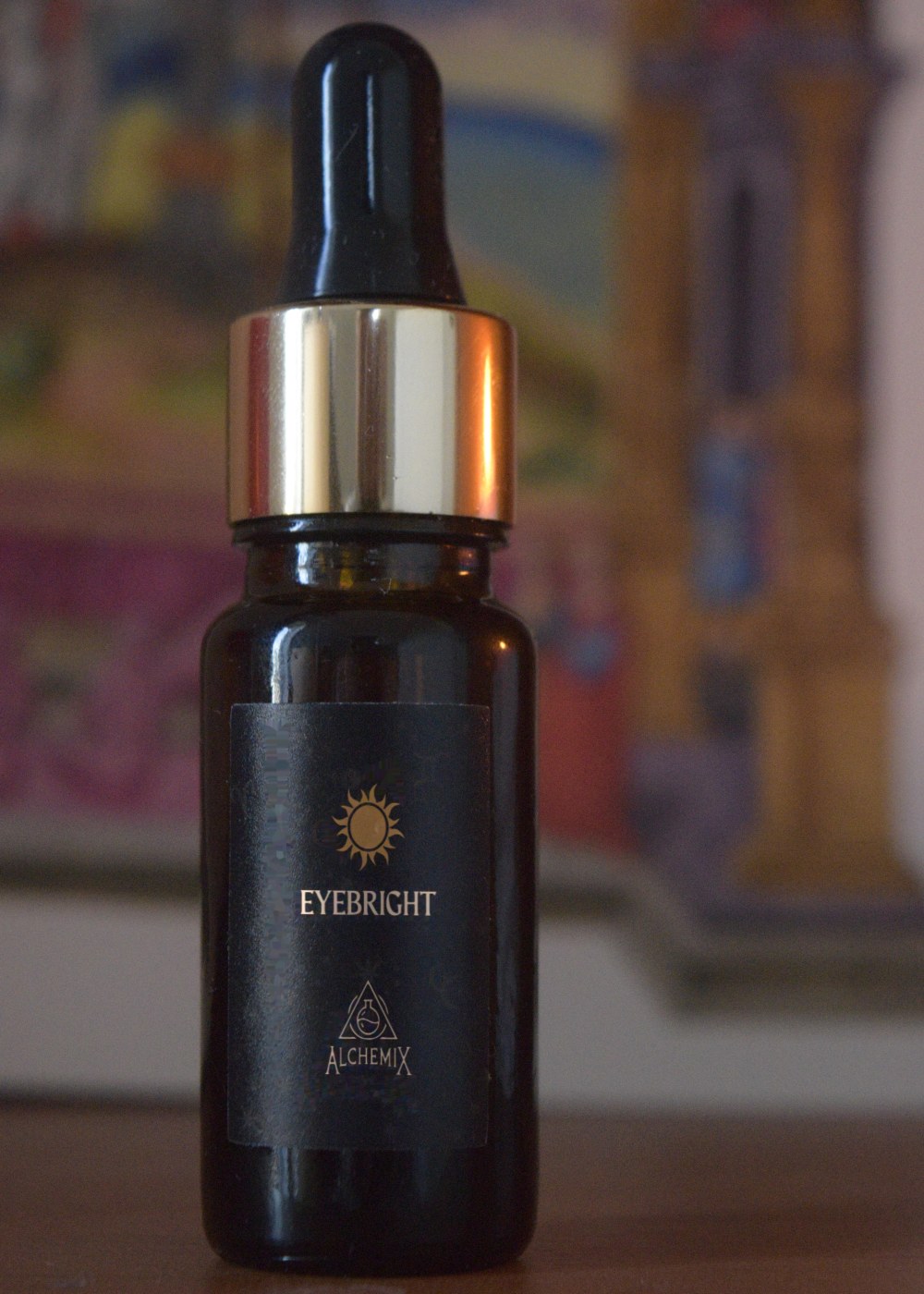
Eyebright is kept in our apothecary as a spagyric tincture in the Solar register, enriched with the plant's own mineral salt. You can see it here. As with everything on our shelves, it is a collector's piece: the history above belongs to the herbalists of the past, and we sell no remedy.