
This article belongs to our Herbarium — a library of what past traditions believed about the great herbs of the Work. It records history, not advice: we describe what herbalists of other centuries did and thought, and we make no claims of our own. Nothing here is a guide to use.
The plant that lit the dark
Mullein's first employment in recorded history was not medicine but light. At the end of its second summer the great flower stalk stands dense, straight and dry as tinder, and for centuries it was cut, dipped in tallow, suet or resin, and carried burning. The flame it gave was slow, steady and stubborn against wind, and old accounts hold that the Romans lit their funeral processions with such torches. Medieval Latin remembered the office in the plant's very names — candelaria, the candle plant, and candela regia, the king's candle, a title German keeps to this day in Königskerze. English gave the same stalk lower company: it was the hag's taper, the witch's candle, lit for less official processions — though the soberer etymologists point out that the name may begin quite innocently in the Anglo-Saxon haege, the hedge, which would make it merely the hedge-taper of the country lanes. Folk memory believed both readings at once, which is the usual way with mullein.
The woolly leaf served the same master by a second route. Its down, rubbed off and dried, takes a spark readily, and it was twisted into wicks for lamps and candles — hence candlewick plant, another of the folk names. Some scholars have even argued that moly, the mysterious white-flowered herb Hermes gave Odysseus against Circe's enchantments, was mullein: the torch plant cast as the guardian against sorcery itself.
The soft one
Say the name aloud and it is already a description. Mullein came into English through the Old French moleine, and most etymologists trace it back to the Latin mollis — soft. The botanical name Verbascum is older still; Pliny used it, and it is commonly read as a worn-down form of barbascum, the bearded plant. Between the soft and the bearded lies the whole character of the leaf: a great grey-green flannel, felted on both faces with fine branching hairs, astonishing to a hand that expected an ordinary roadside weed.
The country names never tired of saying so. Adam's flannel. Beggar's blanket. Old man's blanket. Velvet dock. Feltwort. Our Lady's flannel. And for the stalk, a second family of names with a staff in hand: shepherd's club, Jacob's staff, and Aaron's rod — the dead branch that blossomed. Few plants have gathered so many names, and nearly every one of them is either a torch or a piece of cloth.
Phlomos: the entry in Dioscorides
The Greeks knew the plant as phlomos, a word the ancient ear connected with phlox, flame — the wick-plant announcing itself in its own name. Dioscorides, the first-century physician whose De Materia Medica remained the standard herbal of the Western world for some fifteen hundred years, gave phlomos a careful entry and distinguished several kinds. He held the root, simmered in wine, to be a comfort to those whose breath came hard, and set the leaf down for the homely applications of country practice. From his pages the plant walked, as so many did, into the monastery herbals, and from there into every printed herbal of the Renaissance.
The guardian at the door
Mullein's guardian reputation ran deep and long. It was hung over doorways and stable lintels against ill-wishing, carried in the pocket on lonely roads against beasts and worse, and planted at the boundary where protection was wanted. In the reckoning of the old folk magic it was a herb that drove back the powers of the dark, even as it had lit the dark for mourners — the same stalk a torch in one century and a talisman in the next. Travelers were told to carry it, and the leaf laid in the shoe was believed to keep a walker from weariness on the road — which is also, more plainly, what a piece of natural flannel under the foot will do. The reputation was not even confined to Europe: in India, where the plant also grows, the old accounts report the same fame — mullein held to be a sure safeguard against evil spirits and magic — the guardian office traveling with the plant across a continent and losing nothing on the way.
Flannel, rouge and figs
The gentler offices were domestic, and they show how closely the plant was woven into daily life. Girls without paint rubbed the velvet leaf on their cheeks to raise a blush — Quaker rouge, the name survives, from communities where cosmetics were forbidden but a leaf was only a leaf. It is recorded that Roman women steeped the golden flowers to brighten and gild their hair. Countryfolk lined their stockings with the leaves for warmth in winter. Gerard, in his great Herball of 1597, passed along the report that figs wrapped in mullein leaves did not spoil — the herbalist, for a paragraph, turned grocer's adviser. Fishermen of old are said to have thrown the seeds into still water to daze the fish and bring them up to the surface, a trick the plant's own nature made possible and the game laws eventually forbade. And in the folk practice of Europe — and of North America, after the plant crossed the sea and settled every roadside there — the dried leaf was burned, and its smoke was believed to comfort the chest and free the breath: a conviction the old herbals repeated for centuries, and one that belongs to them and to their time.
The two-year spire
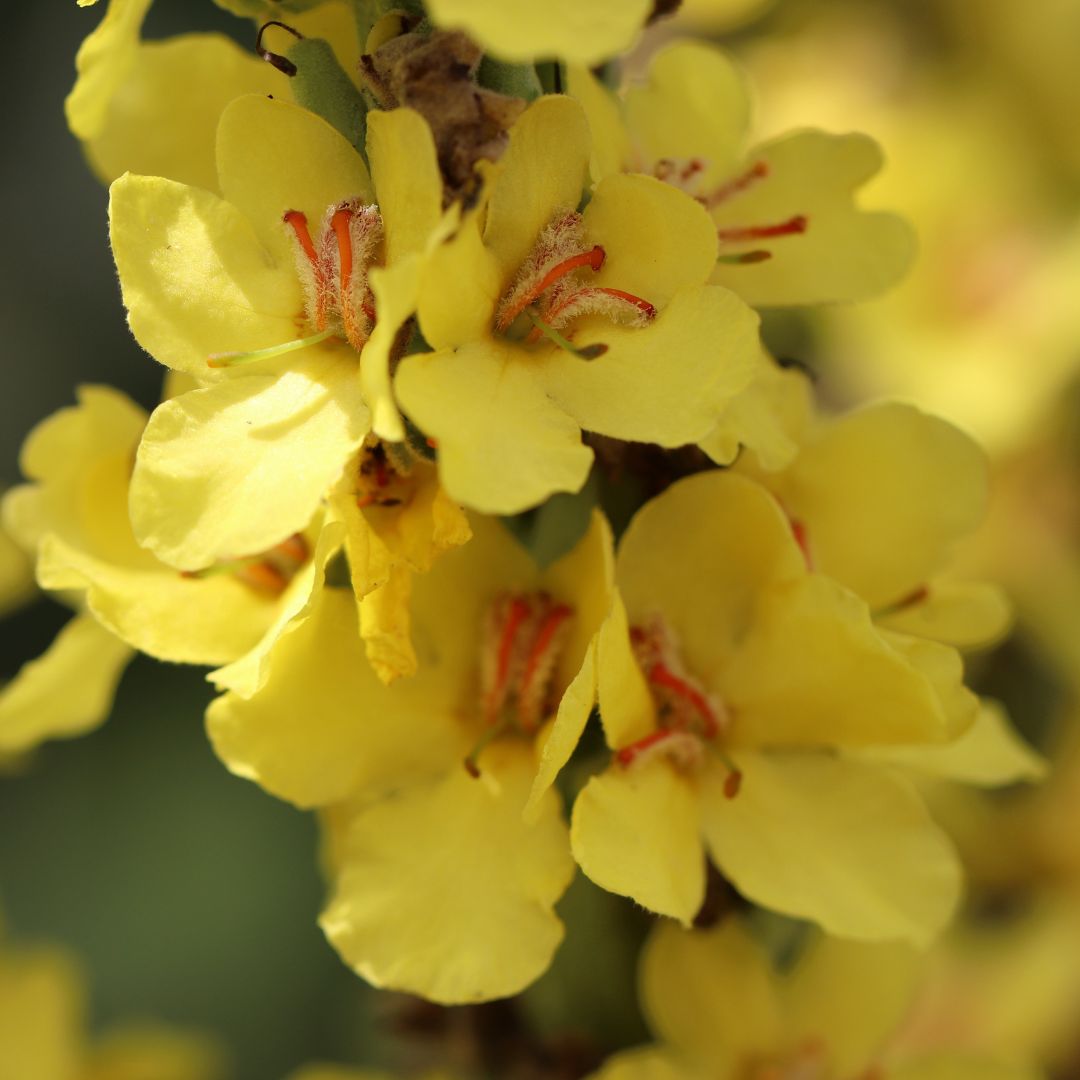
Mullein is a biennial with Saturn's own rhythm. Its first year is spent low and humble: a rosette of woolly leaves pressed flat to the ground, gathering strength and asking nothing. Only in the second does it send up the spire — often taller than a man, sometimes twice so — set with small golden flowers that open a few at a time, each lasting scarcely a day, so that the tower burns slowly upward through the whole summer like the taper it was always taken for. The seed is famously patient: a single spire ripens tens of thousands of grains, fine as ground pepper, and they can wait in the soil for decades until fire or the plough breaks the ground and calls them up. That is why mullein is so often the first tall thing standing on burnt land and fresh embankments — the torch raised over the ruin.
The hermetic tradition read all of this without hesitation. Culpeper set mullein under the dominion of Saturn — the planet of time, patience and slow structure — and the assignment has never been seriously disputed: two years for one flowering, humility before stature, a dry stalk that becomes a light. Its signature is the lit taper of the long night — a slow flame for slow seasons, kept by the melancholic, whom the old herbals held it to console.
The Magical Properties of Mullein
Long before it was anything else, mullein was a plant of the threshold and the flame, and the old magic read it accordingly. Where a herb gives light, folk belief gives it the office of driving back the dark — and mullein, the tall dry taper of the waysides, carried that reputation across Europe and beyond. It was reckoned a herb of courage and of guardianship, a thing to keep about the person on a lonely road and to set at the edge of a property where safety was wanted. The old grammar here is the alchemist's own: that a plant's plainest habit — in mullein's case, to stand straight and burn slow and steady — was taken to betray the virtue the tradition assigned it. What is a spagyric tincture? sets out that older way of reading a herb's character.
Hag's Taper: Mullein in Folklore and Witchcraft
The name that clings hardest is hag's taper. The dried second-year stalk, dense as tinder, was dipped in tallow and lit as a literal torch — and it was these mullein tapers that folk memory placed in the hands of funeral and graveyard processions, which is how the plant earned its long association with the churchyard and the witch's candle. The soberer etymologists, as ever, offer the hedge — Anglo-Saxon haege — as the quieter root, but the tradition believed the darker reading too. In the old witch-lore the burning stalk was more than light: its smoke was carried to banish what was unwelcome and, folk reckoning held, to thin the veil between the seen and the unseen when divination was wanted. The taper that lit the mourner's road was, in the same hand, a wand raised against the dark.
Mullein as a Guardian: Protection and Banishing
Mullein's guardian office was old and widely held. The stalk and leaf were hung over doorways and window-lintels to turn back ill-wishing, set at the boundary of house and stable, and carried in the pocket on dark roads for the courage such a talisman was believed to give. Older still is the tale the Greeks told: that the moly Hermes — Mercury, to Rome — pressed on Ulysses against the enchantments of Circe was this very plant, the torch-herb cast as the sovereign guard against sorcery itself. Roman soldiers, the accounts say, dipped mullein stalks for their lamp-wicks and were held to carry something of the plant's steadiness with them. From the classical page to the cottage lintel the reputation never wavered: mullein was set at the threshold, and what wished harm was believed to be held on the far side of it.
Mullein and the Planet Saturn
The hermetic astrologers set mullein under Saturn, and Culpeper states it plainly. The fit is in the plant's own clock: two full years for a single flowering, a first season spent low and humble in its grey rosette before the second sends up the spire — humility before stature, the slow structure and long patience that are Saturn's signature entire. Agrippa, it is true, once ranged the plant under Mercury, fittingly for a herb tangled with the messenger-god's gift to Ulysses; but the weight of the tradition, and the plant's Saturnine rhythm, keep it in the elder planet's house. Its signature was read as the lit taper of the long night — a dry stalk that becomes a slow flame, the discipline of the melancholic and the patience that waits two years to burn.
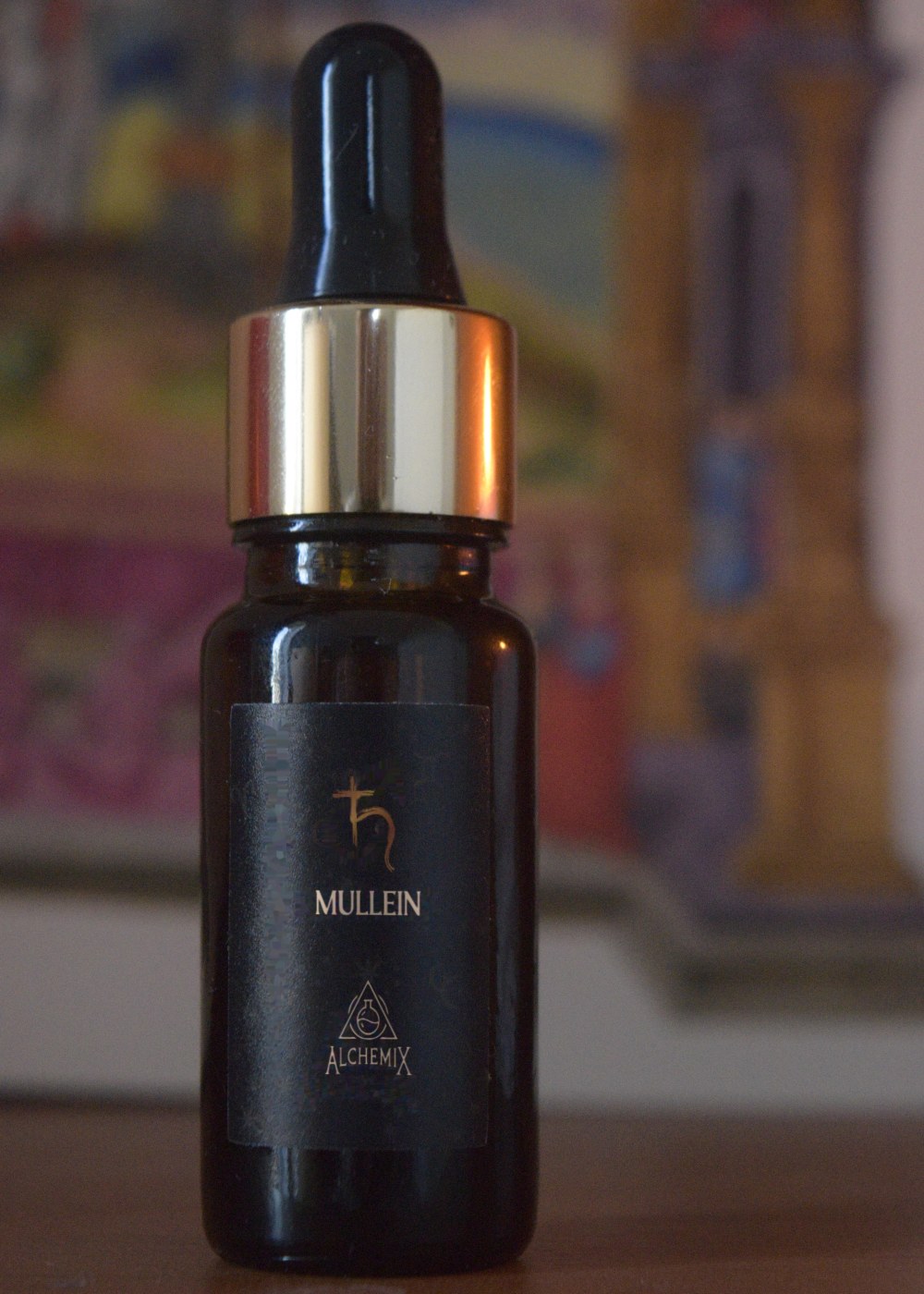
Mullein is kept in our apothecary as a spagyric tincture in the Saturnian register. You can see it here. As with everything on our shelves, it is a collector's piece: the history above belongs to the folk traditions of the past, and we sell no remedy.