
This article belongs to our Herbarium — a library of what past traditions believed about the great herbs of the Work. It records history, not advice: we describe what herbalists of other centuries did and thought, and we make no claims of our own. Nothing here is a guide to use.
Dry love
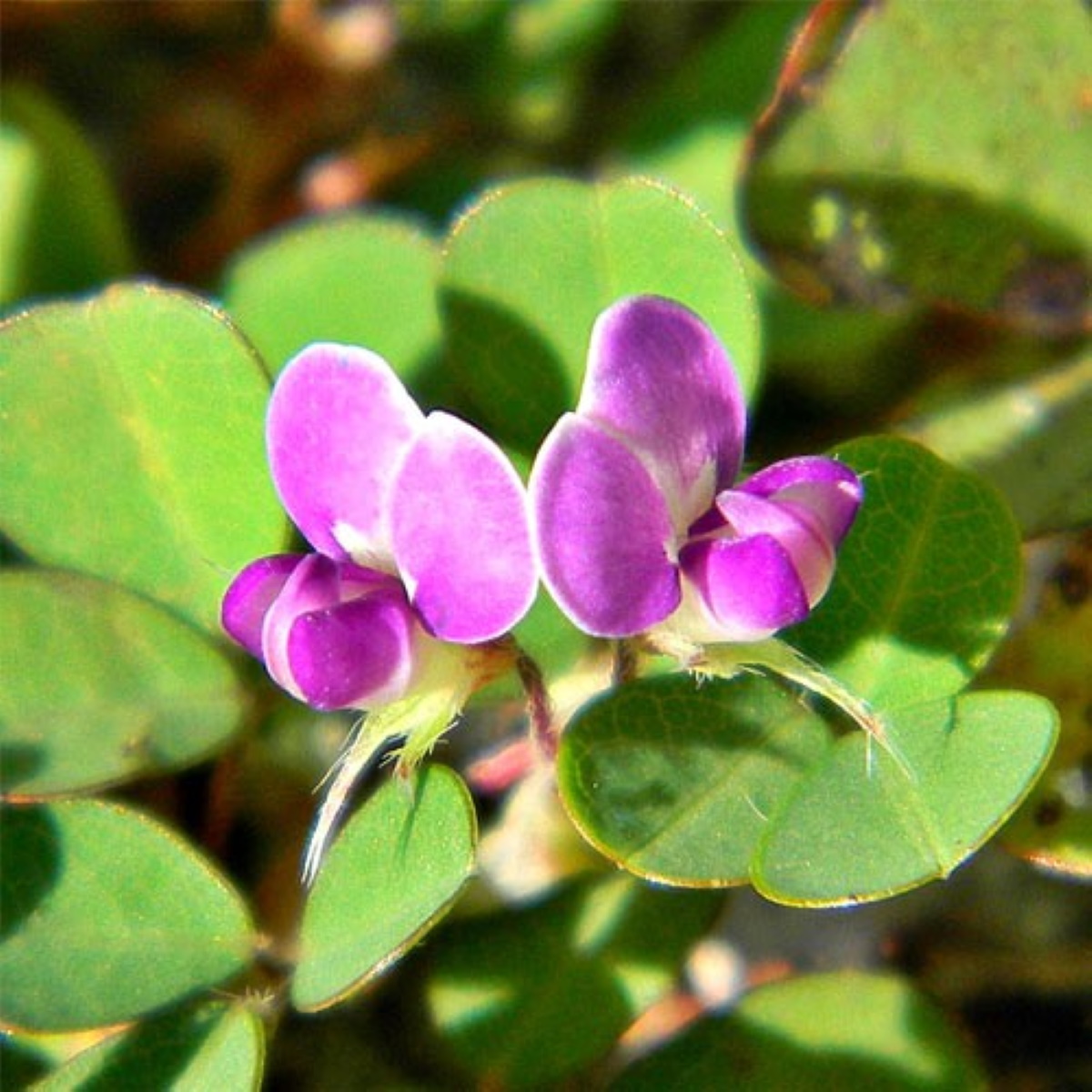
Desmodium adscendens is a modest creeping legume of the American tropics and the eastern flanks of the Andes, a low sprawling plant of the pea family with small trifoliate leaves and slender spikes of little pink-purple flowers. There is nothing rare or dramatic about it; it grows in disturbed ground, along paths and field edges, the sort of green that a walker steps over without a glance. Yet across Spanish-speaking South America it carries an outsized reputation, and two names that between them tell most of its story.
The first is amor seco — "dry love." The plant fruits in flat, jointed little seed pods, loments, whose segments are covered in tiny hooked hairs; they break off at a touch and cling to clothing, to fur, to the hem of a passing skirt, and will not be shaken loose. Anyone who has walked through a stand of it comes out carrying a fringe of the plant on their trousers. A green thing that attaches itself to every passerby and refuses to let go earns a wry name, and the country people gave it one: love that has dried out and clings anyway. The second name is the Quechua one, manayupa, read in the folk tradition as a kind of boast — a plant whose uses are past counting, more than a person could tally. Between the affectionate Spanish and the admiring Quechua sits the whole reputation of the herb: humble, ubiquitous, and held in a regard out of all proportion to its looks.
The world of the curandero
To understand what manayupa meant, it helps to understand the tradition that prized it. The curandero — from curar, to heal — is the folk healer of the Andes and the coast of Peru, heir to a body of practice far older than the Spanish word for it. That practice was never a pharmacy of isolated remedies. It was a whole way of reading a person: their body, their spirits, their standing in the family and the community, and the unseen currents the tradition believed ran through all of these at once. The healers did not draw the hard line the modern world draws between the sickness of the body and the sickness of the life. A person could be out of order, and the disorder could show anywhere.
Within that system, plants were sorted less by the single thing they were thought to do than by the kind of work they were thought to perform — warming or cooling, opening or binding, and above all cleansing. The great cleansing herbs held a special rank, because so much of the tradition's understanding of misfortune was an understanding of accumulation: something taken on, gathered, retained, that ought to be let go. Manayupa belonged among these. The healers held it to be one of the great purifiers of the highland pharmacopoeia, a plant reached for when the work at hand was clearing rather than adding.
What the tradition believed
The belief attached to manayupa was, at its center, a belief about release. The curanderos held that it purged what the body no longer needed — and, because in the Andean way of seeing the body and the emotions are one household, they held that the same herb loosened what the temper had stored. Old angers, resentments, the heat that settles in a person and turns sour with keeping: these were spoken of in the tradition as things that lodged and had to be moved, no less than any bodily residue. Cleansing, in that cosmology, was never a merely physical event. To rinse the vessel and to cool a stored fury were understood as the same operation carried out in two rooms of one house.
It is worth pausing on the choice of plant for such work. The tradition might have reached for something violent — the pharmacopoeia of every culture holds its share of fierce purges — and it did not. It reached instead for a mild, clinging, unglamorous roadside legume, the very plant that hitches a ride on the traveler's hem. The gentleness was the point. The cleansing manayupa was believed to perform was a patient one, a coaxing loose rather than a scouring out, and the healers' esteem for it seems bound up with exactly that mildness: a herb one could turn to often, without drama, the workhorse of the clearing rather than its shock-troop.
The herb sellers of the sierra
None of this lived only in the memory of specialist healers. It lived, and lives, in the market. Walk into the mercado of a highland town — Cusco, Huancayo, Cajamarca — and among the stalls of potatoes and cloth there will be a section given over to dried plants, the domain of the yerbateras, the herb women, who sit behind heaped baskets and tied bundles of leaf, bark and root. This is where the folk pharmacopoeia has always been kept: not in a book but in the standing knowledge of the sellers, passed down and asked for by name. To buy manayupa in such a market is to buy into a long unbroken transmission — the customer names an intention, the seller reaches into the right basket, and a bundle of the clinging little legume changes hands as it has for longer than anyone at the stall can say.
The herb sellers are the reason a plant like this has a continuous history at all. Written records of Andean folk medicine are thin and late, mostly gathered by outsiders; the real archive was oral and commercial, held in these markets and in the practice of the healers who supplied and were supplied by them. Manayupa's fame is a market fame, and it has kept the plant in demand — and in the ground, gathered and carried down from the high fields — through every century that never troubled to write it down.
The Folklore of Manayupa: Herb of Countless Uses
If a plant's fame can be measured by its name, manayupa was famous before a single word was written about it. The Quechua speakers of the high country glossed manayupa as something close to one cannot quantify it — a herb whose uses, in the old reckoning, were past counting, more than a person could tally on the fingers. It was a boast folded into a name, the kind of tribute a people pays only to a plant they have leaned on for generations. In the folklore of the sierra it stood as the herb of countless uses precisely because no single reputation could contain it; the curanderos and market women who prized it esteemed it, above all, as a plant of many virtues held in high regard. To learn what a spagyric tincture preserves of such a plant is to ask what that regard was made of.
Amor Seco — the 'Dry Love' of the Andes
The Spanish gave manayupa a second name, and it is the more affectionate of the two: amor seco, "dry love." The tenderness is a joke about the seeds. The plant's jointed little pods are hooked with tiny barbs, and they break off at a brush of the leg and ride away on the traveller's hem, the dog's coat, the shepherd's wool, refusing to be shaken loose. A green thing that fastens itself to every passer-by and will not let go earns exactly this wry endearment: love gone dry that clings anyway. In the love-lore of the country the clinging seed became a small emblem of devotion that outlasts its season — an attachment that holds past all reason to hold. It is a name for a lover as much as for a legume, and the Andes, wisely, kept both meanings.
Manayupa in Andean and Inca Herbal Tradition
Manayupa belonged to a green knowledge far older than the Spanish word curandero. Long before the conquest, the peoples of the Andes had ordered their world of plants with great care, sorting the herbs of the high fields by the kind of work each was thought to perform and carrying that lore down the generations by mouth and by market rather than by book. The herb was a plant of the mountain healers, gathered from the disturbed ground of the eastern slopes and esteemed in the curanderismo of Peru as a herb of many offices. In that tradition it was reached for and spoken of with respect, its standing kept alive in the baskets of the yerbateras of Cusco and Cajamarca. What the old healers held it to be was a matter of reputation and inheritance — a name asked for, a bundle handed across, a regard passed on intact.
Manayupa and the Planet Venus
In the hermetic register we keep, manayupa sits under Venus — and the fit is pleasing. Venus is the old green goddess of growing things, of copper and of Friday, of sweetness, softness and the bonds that draw one thing gently toward another; and here is a plant whose very by-name is amor seco, whose seeds are the Andes' small parable of an attachment that will not release its grip. A herb of love in the country's mouth, standing under the planet of love in ours: the correspondence writes itself. Where other plants of the pharmacopoeia were assigned to the fierce planets, manayupa keeps to Venus's quieter dominion — the register of green kindness rather than force, of the clinging seed and the affectionate name. It is, in every sense the old herbalists would have recognised, a plant of Venus.
Venus and the gentle purifier
The hermetic reading we keep sits easily on such a plant. Manayupa stands, in our register, under Venus — not the Venus of romance alone but the older Venus of green growing things, of softness, of the work done by kindness rather than force. Its signature is purification by gentleness: the rinsing of the vessel, not the scouring of it, the patient loosening of what clings so that something finer might be poured in. That a plant named for its own inability to let go should be held, above all, as a herb of letting go is the kind of quiet paradox the old herbalists loved. The dry love that will not release its grip on the traveler was believed, in the healer's hands, to be the very thing that helps a person release their grip on everything they no longer need to carry.
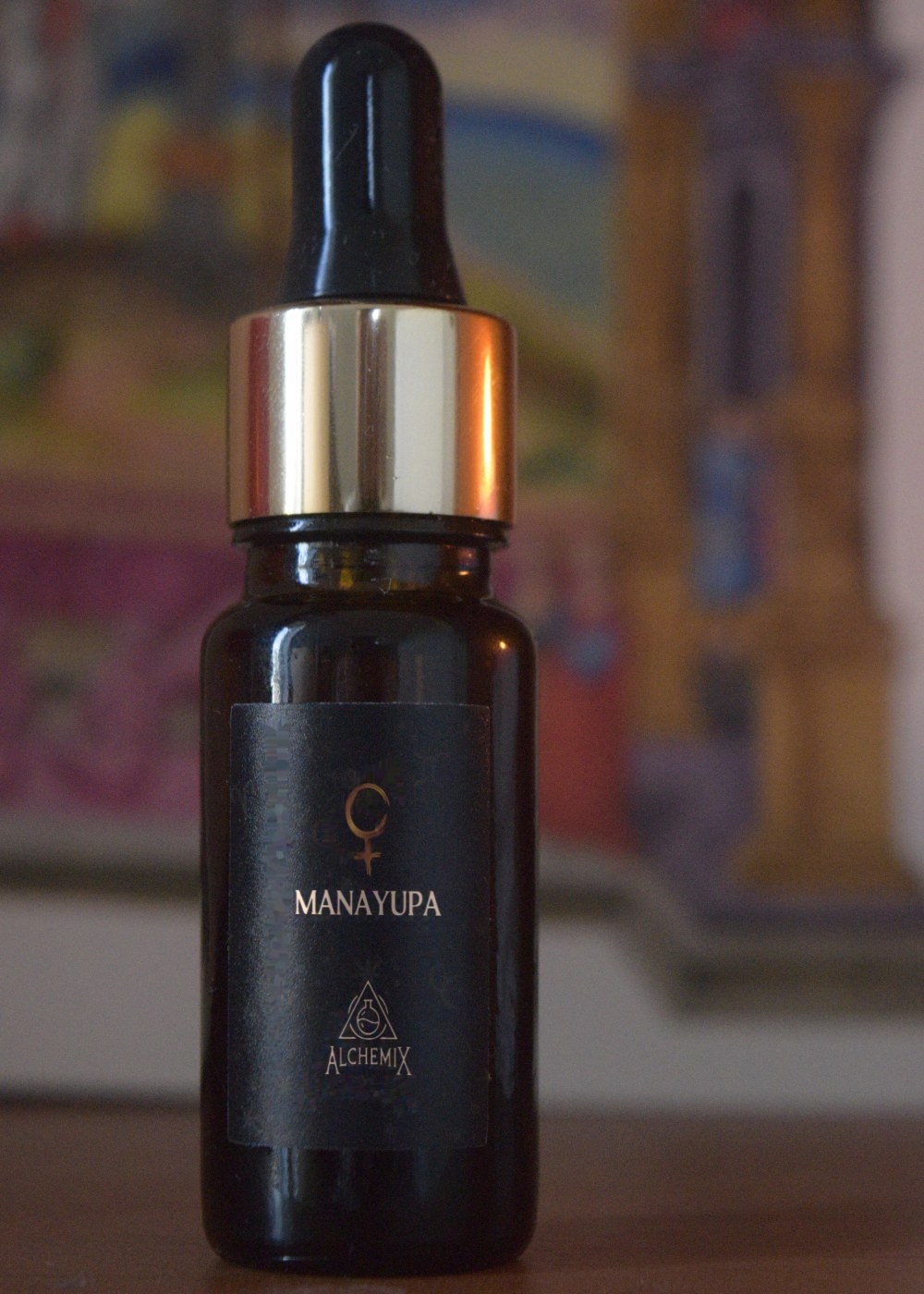
Manayupa is kept in our apothecary as a spagyric tincture in the Venusian register, with the plant's mineral salt returned to the vessel. You can see it here. As with everything on our shelves, it is a collector's piece: the history above belongs to the healers of the Andes, and we sell no remedy.