
This article belongs to our Herbarium — a library of what past traditions believed about the great herbs of the Work. It records history, not advice: we describe what herbalists of other centuries did and thought, and we make no claims of our own. Nothing here is a guide to use.
Named for a weapon
Tribulus is Latin for the caltrop — the four-spiked iron burr that armies scattered before cavalry, engineered so that however it lands, one spike always points up. The Roman military writer Vegetius described the device in his manual on the art of war, and ancient historians tell of spiked ground sown against Alexander's horsemen; from the legions to the medieval castle yard to the twentieth century's airfields, the caltrop is among the oldest weapons never to go out of service. The Greeks called it tribolos, "three-pointed" — and they gave the very same name to a plant, because the plant had arrived at the design first. The woody seed of Tribulus terrestris is built on exactly the caltrop's geometry, and anyone who has stepped on one barefoot understands the military reference immediately. The borrowing runs deep into the language. The Latin Bible promised fallen Adam a ground bearing "thorns and tribuli" — English translators wrote "thistles," but the caltrop stood in the Latin — and the word tribulation descends from the same spiked family, by way of the tribulum, the studded threshing-sledge. A small creeping vine, in short, with an uncommonly hard name to live up to. It lives up to it.
A portrait of the plant
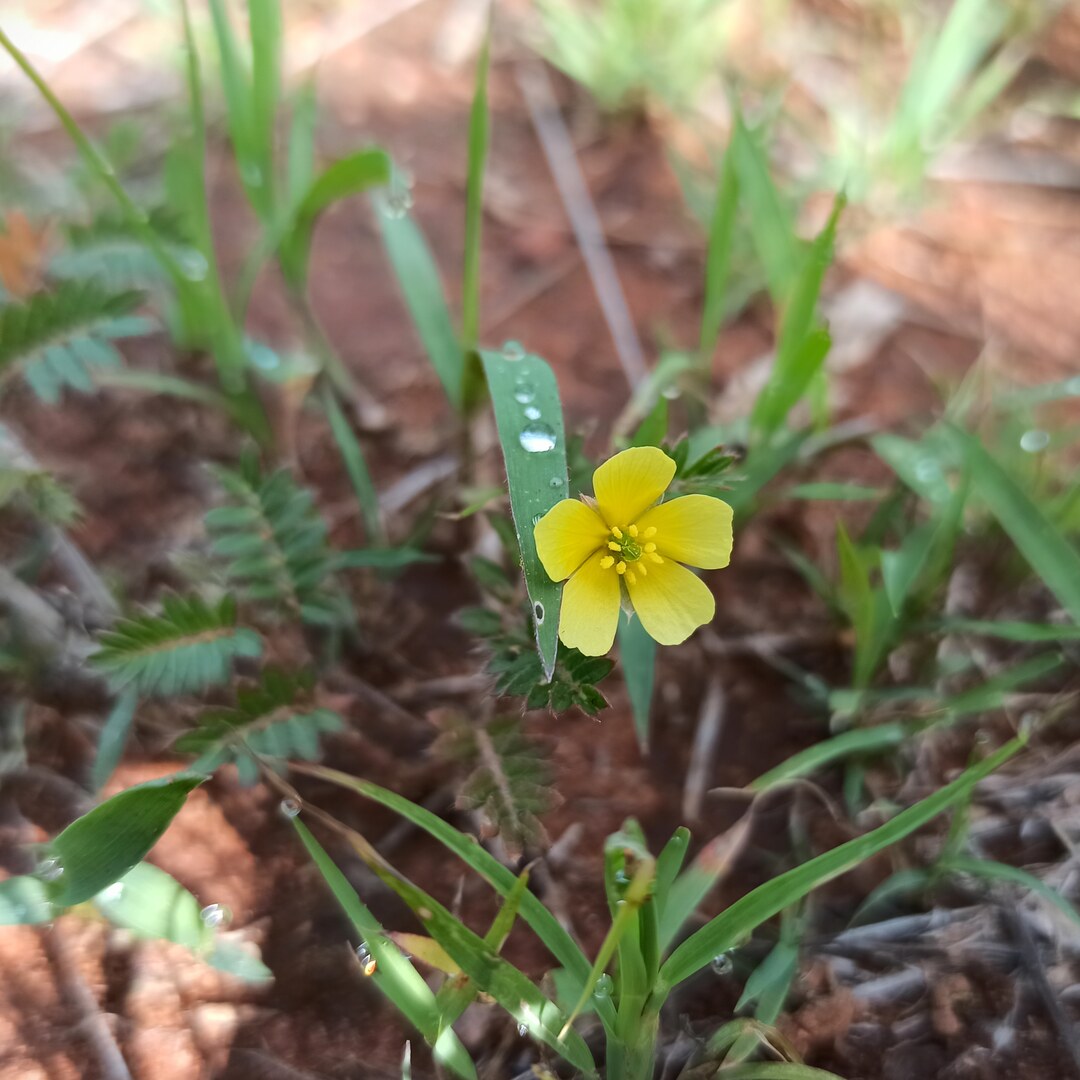
Off the battlefield of etymology, the plant itself is almost dainty. Tribulus is a prostrate annual: slender stems radiate from a central taproot like the spokes of a wheel and lie flat along the ground, dressed in small paired leaflets silvered with silky hair. The flowers are five-petaled, butter-yellow, and small enough to miss entirely — they open to the morning sun and are often closed again by midday. Then comes the fruit, and the daintiness ends. The ripening burr hardens to wood and splits into five wedge-shaped nutlets, each armed with a pair of long rigid spines and a row of shorter ones, so that a single plant lays down its own minefield by late summer. The whole vine hugs the earth — it rarely rises more than a hand's height — which is, of course, precisely where a caltrop belongs.
The ecology of hard ground
Tribulus does not merely tolerate hard ground; by every appearance it prefers it. It is a plant of the compacted roadside, the trampled farmyard, the railway margin, the crack in the pavement — places where the soil is beaten airless, the summer is pitiless, and nearly everything gentler has already surrendered. The deep taproot finds water no one else can reach; the flat mat of stems escapes the mower and the grazing mouth alike. And the burr is the whole travel strategy: it lies at ground level and waits for a hoof, a boot-sole, a paw, a bicycle tire, then rides its victim to new ground. A single plant can lay down hundreds of burrs in a season, and the seed is famously patient — it can wait in the soil for years for its summer to come. By this method the vine has walked out of the Old World and around the planet, and everywhere it arrived it was given the same kind of name. Americans — who are believed to have received it in the wool and hooves of imported livestock — call it puncturevine and goathead; older English books call it devil's thorn; the Spanish had long called it abrojo, a word said to descend from the Latin warning aperi oculos, "open your eyes." It is one of the few plants in this Herbarium that is chiefly famous, across half the world, as a curse word.
The Greek record
The plant stands in the European record from the beginning. Theophrastus, the father of Greek botany, already counted the tribolos among the spiny plants; and Dioscorides — the first-century physician whose De Materia Medica remained the standard herbal of the West for fifteen hundred years — described two caltrops, one of the land and one of the water, the land kind creeping low with its armed fruit, familiar along paths and riverbanks. The old Mediterranean, in other words, knew the plant exactly as the modern roadside does: by its geometry, and mostly through the sole of the foot.
The cow's hoof
In Ayurveda the plant is gokshura — the name is usually read as "the cow's hoof," though some prefer the earthier "cow-scratcher" — named for where it grows and for what its burr does underfoot. Its standing in that tradition is anything but marginal. The great classical compendia, the Charaka Samhita and the Sushruta Samhita, list it repeatedly; it belongs to the laghu panchamula, the "five small roots," and through them to the celebrated dashamula, the ten roots — one of the most famous root formulas of the entire tradition. The classical texts counted it among the plants of vigour and generative fire, and the branch of the science devoted to strength and virility reached for it by name. It was believed to restore the body's fire, stamina and generative strength where they had run dry; and the conviction traveled well beyond the Sanskrit texts. The Unani physicians of the Persian and Mughal world kept the burr in their books as khar-e-khasak, and the folk healers of the old world, from India across to the Mediterranean, arrived independently at much the same belief. A plant that flourishes in exhausted soil, given for exhausted men — the doctrine of signatures at its bluntest.
The burr in the Chinese herbal
The plant's eastern career did not stop at India. The fruit appears in the Chinese materia medica as ji li, and it is listed in the oldest surviving Chinese herbal, the Shennong Bencao Jing — the Divine Farmer's classic, compiled around the beginning of our era. The physicians of that tradition reasoned, characteristically, from the form: a thing so armed, they held, must be by nature a piercer and a scatterer, and they matched the spiked burr to whatever in a patient had grown knotted, pent-up and stuck. Three great traditions, three readings of one small weapon — strength in India, dispersal in China, and in Greece a name learned chiefly through the foot.
Mars in the dust
No hermetic assignment was ever easier: Mars, the armored planet, ruling a weapon that grows out of the ground. The Renaissance readers of signatures, who could labor for pages over a subtler plant, had nothing to do here but point. The signature is force held in a small hard vessel — the iron seed of the badlands, the vigour of things that refuse poor circumstances as an excuse. Every culture that named the plant reached for war, for the devil, or for the memory of a wounded foot; every tradition that kept it in its books reached for strength. It is the same reading twice over. The caltrop vine is what it appears to be, all the way down — which, in the herbals as in war, is its own kind of honesty.
The Caltrop Vine: How a Seed Named a Weapon
Long before it named a plant, tribulus named a weapon. The Latin word, borrowed in turn from the Greek tribolos, belonged first to the caltrop — the four-spiked iron burr that armies of antiquity scattered across the ground so that, however it fell, one point always stood upward to lame a horse or pierce a marching foot. Old English called the same device the calcatrippe, the "heel-trap," a word that survives, faintly, in our caltrop today. And here is the quiet joke the language kept: the woody seed-burr of Tribulus terrestris is itself a natural caltrop, grown by the plant on the very geometry the smiths would later copy in iron. The weapon took its name from the seed, or the seed from the weapon — by the end the two had grown indistinguishable, and a small creeping vine wore the name of an instrument of war.
Gokshura, "Cow's Hoof": The Meaning of the Name
Half a world from that battlefield, the same burr earned a gentler name. Sanskrit called it gokshura — go, the cow, joined to kshura, the hoof or the scratch — so the word reads at once as "cow's hoof" and "cow-scratcher," born of the print the plant left underfoot and the mark its spines drew across a passing shin. The old texts set the word down in writing: the Charaka Samhita and the Sushruta Samhita, the twin pillars of the Ayurvedic library, both named the burr and kept it through the long centuries of their copying. It is a name of pure observation, owing nothing to any doctrine — the herb described by the animal that trod on it, as plainly as the Greek had described it by the shape of its thorn.
Gokshura in the Ayurvedic Texts
Within those texts the burr was no marginal weed. The compilers filed it among the laghu panchamula, the "five small roots," and through that grouping into the celebrated dashamula, the ten roots that anchored some of the tradition's most storied formulas. To be named in both the Charaka Samhita and the Sushruta Samhita, and to be kept there across the copying of ages, was to hold a settled place in the oldest written herbalism of India. The physicians who catalogued it read the plant, as physicians of every old tradition did, partly through the form of the thing itself — the conviction that a plant's outward shape disclosed its inward nature. What they made of that reading belonged wholly to their world and their centuries, and is recorded here as history, and as nothing more.
Tribulus and the Planet Mars: The Martial Herb
Of all the hermetic assignments, none was ever plainer than this one. Mars — the armored planet, lord of iron and of war and of every sharp edge — could claim no better emblem than a weapon that grows out of the dust. The correspondence writes itself: spikes, iron, the strewn field, the wounded foot, all the furniture of the god of battle gathered into a single creeping vine. The same instinct that armed the legions armed swordsmen half a world away; the Japanese makibishi, the caltrop of the feudal warrior, was scattered behind a retreat to slow a pursuer — the very same idea in another tongue and another metal. To read the plant as martial is to read it exactly as it looks. Those who wish to know how such a reading of form becomes a matter of spirit and salt can turn to What is a spagyric tincture?.
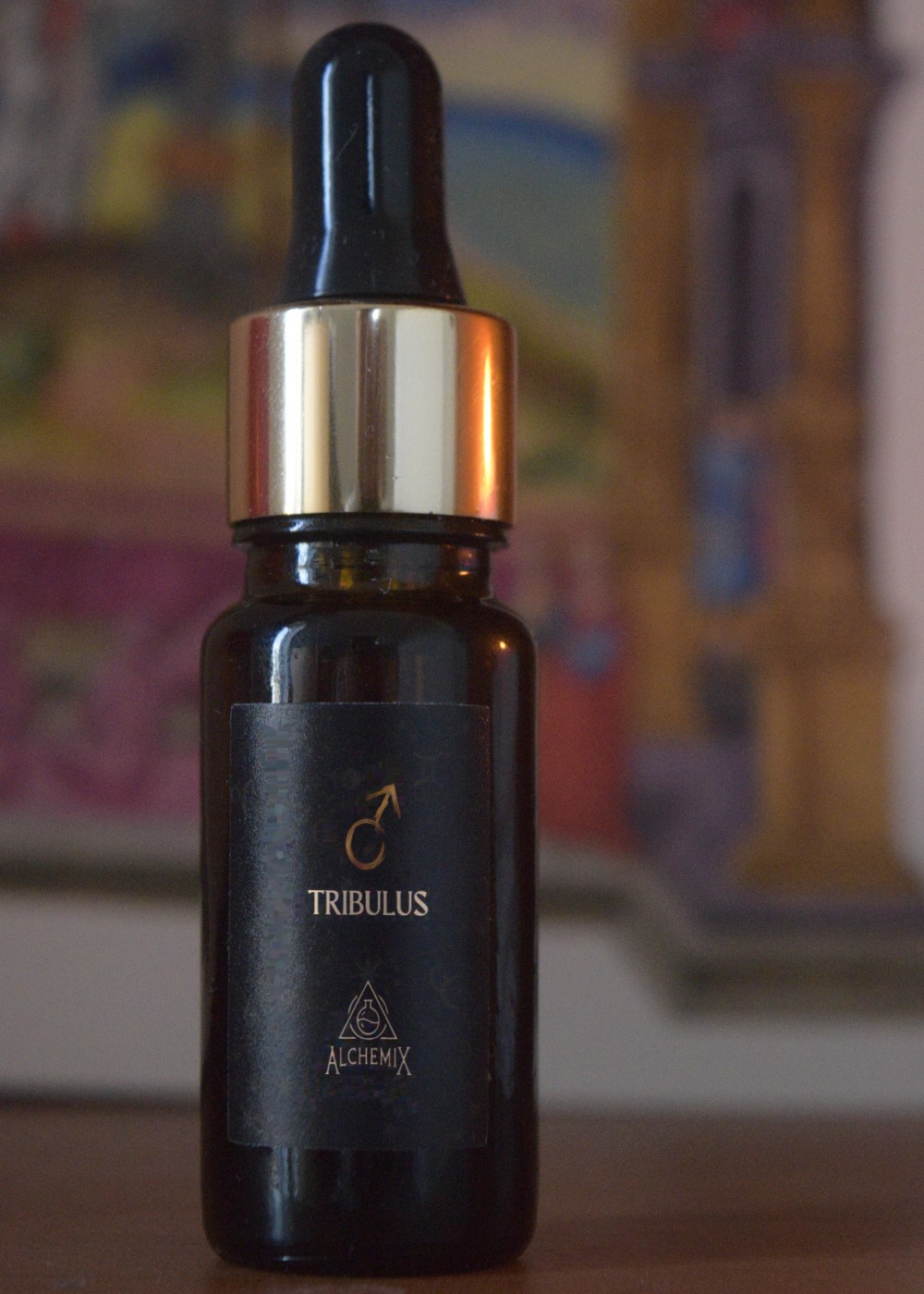
Tribulus is kept in our apothecary as a spagyric tincture in the Martial register. You can see it here. As with everything on our shelves, it is a collector's piece: the history above belongs to the old traditions, and we sell no remedy.