
This article belongs to our Herbarium — a library of what past traditions believed about the great herbs of the Work. It records history, not advice: we describe what herbalists of other centuries did and thought, and we make no claims of our own. Nothing here is a guide to use.
The tree of strength
The Greeks named it first. Crataegus comes from kratos — strength — a name the old botanists tied to the tree's wood, so dense and hard that it was used for tool handles and the engraver's block long after softer timbers failed. Dioscorides, the first-century physician whose De Materia Medica remained the standard herbal of the Western world for fifteen hundred years, already wrote of the thorn tree; and from him the plant walked into every European herbal that followed.
But its oldest fame was never medical. It was the boundary tree — haw is simply the old word for hedge — and the peoples of Europe gave it a spiritual charge that few plants have carried: the tree of weddings, the tree of May, the tree of the fairies, the thorn that flowers at Christmas. The herbal history reads differently once the folklore is understood, so the folklore should come first.
A portrait of the tree
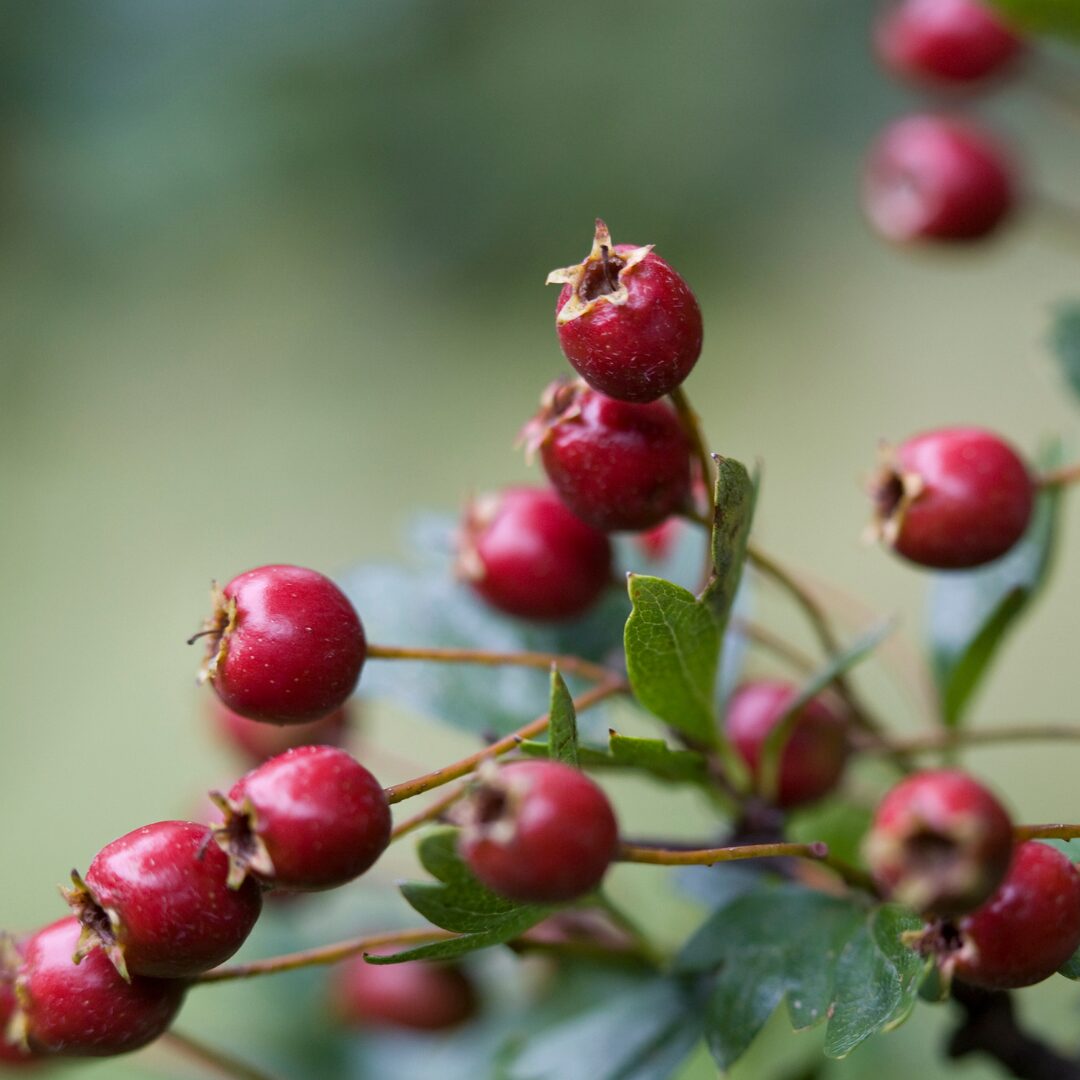
The hawthorn is a rose — a member of the rose family, cousin to the apple and the sloe, and its fruit, the haw, is built like a tiny apple around its stone. Botanists in Britain distinguish two native species, the common hawthorn with its single seed and the Midland hawthorn with two, and beyond them a crowd of freely interbreeding forms that long ago taught the cataloguers humility. It is a small tree, rarely much past thirty feet, armed at every joint, and patient — a hawthorn can stand for centuries, growing more sculptural with each decade. Above all it is the hedge tree. "Quickset" — a hedge planted from living cuttings — meant hawthorn by default, and when the English Parliament enclosed the open fields in the eighteenth and nineteenth centuries, the new geometry of the countryside was drawn in hawthorn: by common estimate, some two hundred thousand miles of it. Country children ate the tender spring leaves straight from the branch and called them bread-and-cheese — a folk name that survives wherever the hedges do.
Hymen's torch
The Greeks married under it. The blossom was woven into bridal crowns, and the wedding torches carried before the bride to her new house were of hawthorn wood, for the tree belonged to Hymen, god of marriage. Rome kept the custom and added its own. Ovid tells, in the Fasti, how Janus gave the nymph Cranaë a branch of whitethorn with the power to ward harm from doorways, and Roman parents were said to lay hawthorn leaves in the cradle to keep evil from a sleeping child. The pattern repeats: at the threshold of marriage, of the house, of a life — the boundary tree, posted at every crossing that mattered.
The month of the May
In England the tree and the month share a name: hawthorn blossom is simply "the may," and "bringing in the may" meant going out at dawn on May Day to cut flowering branches for the doors and the village green. The May Queen wore it. The proverb "ne'er cast a clout till May be out" — do not shed a layer of clothing too soon — may mean the month or may mean the blossom, and folklorists still argue which. When England reformed its calendar in 1752, May Day slid eleven days earlier against the seasons — and the hawthorn, which had flowered obligingly for the old date, has been late for its own festival ever since. One rule was never relaxed: the blossom was for out of doors. Brought inside, it was believed to invite death into the house, and country people said the flowers carried the smell of plague. The may was welcome on the door and dreaded on the table — a tree honored, always, at arm's length.
The fairy thorn
Ireland gave the tree its deepest reverence and its strictest law. The lone hawthorn standing by itself in a field — the sceach, the fairy thorn — belonged to the other world, and to cut one was to invite a misfortune no sensible person would price. Farmers plowed around them; roads bent for them; the tales of ruin that followed the axe were told in every county, and there are farmers to this day who will not test them. At holy wells the hawthorn served as the rag tree, its branches tied with strips of cloth left by petitioners — each rag a prayer slowly weathering. Nor has the old law entirely lapsed: in 1999, after a campaign led by the storyteller Eddie Lenihan, the route of a new motorway in County Clare was adjusted to spare a famous fairy thorn at Latoon. It is a pleasing symmetry that the same county — as we shall see — gave the berry its medical fame.
The thorn that flowers at Christmas
The most famous single hawthorn in the world grows, in its successive descendants, at Glastonbury in Somerset. Legend says that Joseph of Arimathea, coming to Britain after the Crucifixion, drove his staff into the soil of Wearyall Hill, and the staff took root and leafed: the Glastonbury Thorn. The tree behind the legend is real and genuinely strange — a form of the common hawthorn that flowers twice, once in May and once in the dead of winter — and it is traditionally propagated by grafting, for the story insists that cuttings of the holy thorn will not strike in ordinary ground. The original is said to have been felled by a Puritan soldier in the era of the Civil War. Its grafted descendants carry on, and for the last century a sprig of the winter blossom has been cut each December and sent to the reigning monarch for the Christmas table — folklore, for once, with a standing appointment.
What the herbalists believed
The medical reputation of hawthorn is a story told in two halves, on two sides of the world.
In China, the fruit of the native hawthorn — shan zha, the mountain haw — has been part of the recorded pharmacopoeia for well over a thousand years. The physicians of the Tang and Song gave it above all for the stomach: it was believed to dissolve stagnant food, particularly the heaviness that follows fatty meat, and to this day candied shan zha is sold on sticks — tanghulu — in Beijing street markets as a digestive sweet. Where Europe would come to see the heart in hawthorn, China saw the digestion.
In Europe, the berry's great fame came late and arrived with a story worthy of the plant's folklore. Through the Middle Ages the herbals record its use in scattered ways — for the stone, for dropsy, as an astringent for fluxes — but the heart tradition begins in earnest in the closing years of the nineteenth century, in County Clare, Ireland. A physician of Ennis, Dr. Green, became famous through the west of Ireland for a heart remedy he refused to disclose; patients traveled to him from across the country. Only after his death in 1894, the story goes, did his daughter reveal the secret: a tincture of ripe hawthorn berries. The account crossed the Atlantic into the journals of the American Eclectic physicians — the herbal doctors of that era — who took up the berry with enthusiasm, and by the early twentieth century hawthorn had become, in their words, a remedy for the aging and the weary heart.
The twentieth century's phytotherapists inherited that belief and formalized it. In Germany — where herbal medicine remained inside the medical establishment — hawthorn leaf and flower were eventually monographed by the state's Commission E, the body that reviewed traditional plant remedies, and hawthorn preparations were dispensed there as registered herbal medicines. The old herbalists' conviction, whatever a modern reader makes of it, was specific and consistent: they gave hawthorn for the heart that was growing old, for palpitations and the "nervous heart," and — in the poetic register the tradition never abandoned — for grief, the broken heart in both of its senses.
The doctrine of signatures
The Renaissance herbalists read plants the way scholars read scripture: the outer form was believed to declare the inner virtue. Hawthorn gave them a rich text. The thorn and the blossom on one branch — the drawn blade and the defended tenderness — made it, in the hermetic assignment, a tree of Mars: the guardian at the boundary, the warrior whose ferocity exists to protect what is soft. That the same tree should bound the fields, guard the fairy world, bless the marriage bed and (as the later herbalists believed) keep the heart, would not have surprised a Renaissance reader in the least. To the doctrine of signatures, it was all one sentence spoken four ways.
The berry, the leaf, the flower
The traditions did not even agree on which part of the tree held the virtue. The Irish story is a story about the ripe berries; the Eclectics followed with berry tinctures. The German tradition preferred leaf and flower, gathered at blossoming. The Chinese used the fruit of their own species, dried and sliced. Each tradition was certain of its choice — a good reminder that herbal history is a chorus of convictions, not a single voice.
Hawthorn Folklore: The Fairy Thorn and the Lone Bush
Ireland's lone bush deserves a second look. Where a single hawthorn stood apart in a field — never planted, never felled — the country people read it as a fairy thorn, a bush that belonged to the other world and marked a doorway between this life and that one. To cut such a tree, or even to prune it carelessly, was to court a misfortune no farmer would price; the wise left an offering instead — a rag, a coin, or simply a wide berth — and plowed around the bush as their grandfathers had. Folklorists recorded the same conviction from Donegal to Clare: the lone thorn was a liminal tree, posted at the seam of the worlds, and its solitude was the very sign of its power. It was luck, in the old reckoning, to respect it, and ruin to presume upon it.
The May Tree: Hawthorn, Beltane, and Going a-Maying
Before it was the may of the English calendar, the thorn was the tree of Beltane, the Celtic feast that opened summer at the beginning of May. "Going a-Maying" meant rising before dawn to gather the flowering branches and carry them home in triumph — for the doors, the greens, the May Queen's crown — and the whole rite turned on the blossom's brief perfection. Yet one prohibition held everywhere: the may was for the threshold and never for the table. Branches were hung on the outside of the door and dreaded within it, for country people said the flowers, brought indoors, carried misfortune and the very smell of plague. The tree that crowned the summer's first morning was honoured, always, at the doorframe — welcome at the boundary, forbidden past it. Beltane kept the thorn exactly where the folklore always placed it: at the edge.
Hawthorn's Magical Properties: Protection and the Threshold
The magical properties ascribed to hawthorn gathered, almost without exception, around protection. It was the guardian of the boundary: branches set at doors and windows were believed to turn aside not only the storm — the thorn had an old reputation for warding lightning from a house — but astral intrusion of every kind, the uninvited thing that tried the threshold at night. Roman parents were said to lay its leaves in the cradle; Irish households posted it at the gate. Even the darker lore kept faith with the theme, for the witches' brooms of legend were reputed to be cut, fittingly, from hawthorn wood — the boundary tree carried aloft. Across every telling the thorn did one work: it stood at the crossing and held the line, the drawn blade and the white blossom on a single branch.
Hawthorn and the Planet Mars in the Old Herbals
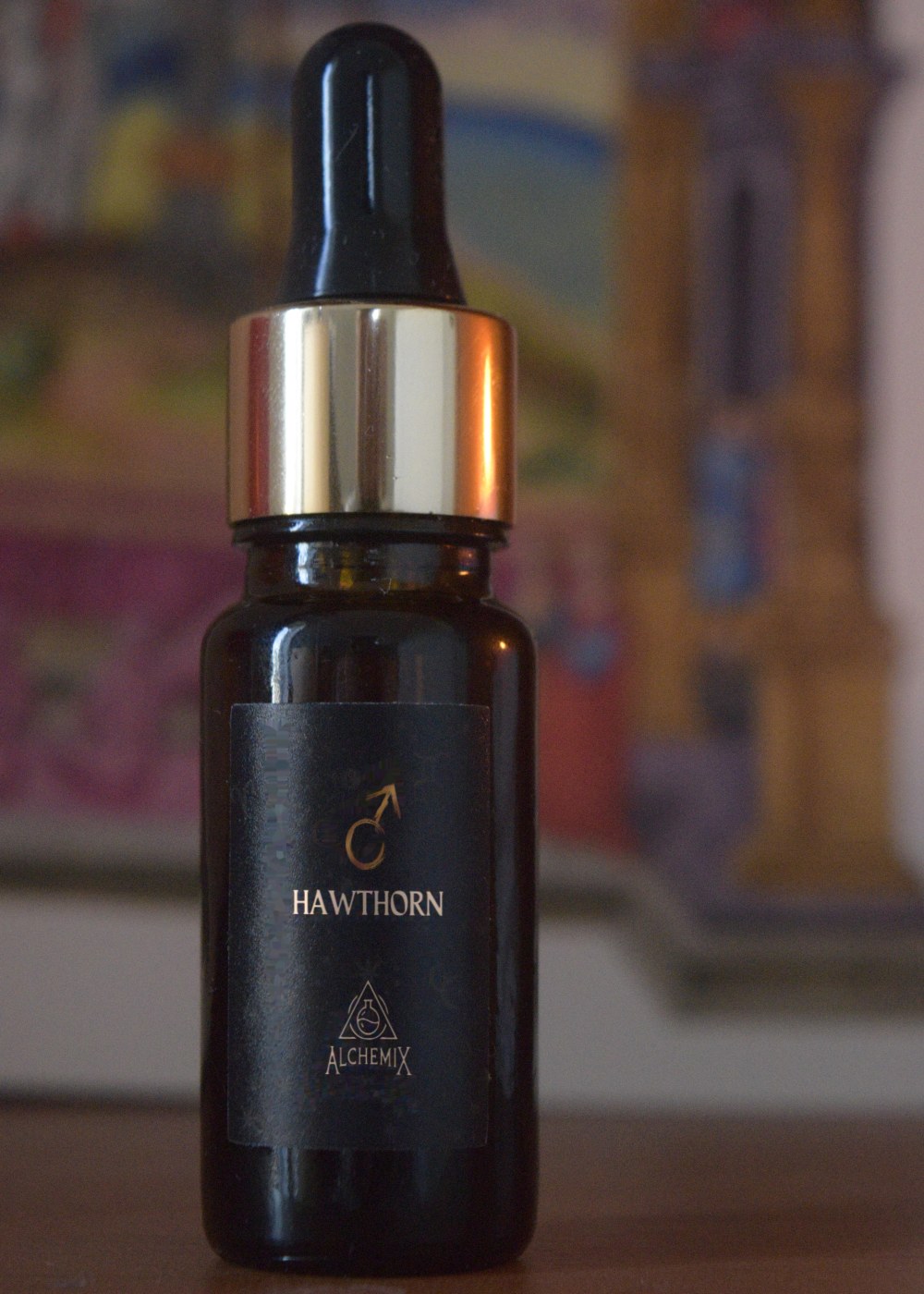
Culpeper assigned Crataegus to Mars, and the doctrine of signatures made the case for him. The thorn and the blossom on one branch — the drawn blade and the defended tenderness — declared a martial virtue: the warrior whose ferocity exists only to guard what is soft, the sentinel posted at every boundary that mattered. In the old cosmology this was Mars at his noblest, iron turned to a shield rather than a sword, and hawthorn took its place among the house's Mars-signed plants for exactly that reason. The spagyric art read the same signature by its own road, drawing the flowering branch's virtue into essence and returning its mineral salt. Hawthorn is kept in our apothecary as a spagyric tincture of the may — a collector's piece in the Martian register, and nothing to be swallowed.
Hawthorn is kept in our apothecary as a spagyric tincture in the Martian register, prepared from the flowering branch. You can see it here. As with everything on our shelves, it is a collector's piece: the history above belongs to the herbalists of the past, and we sell no remedy.