

This article belongs to our Herbarium — a library of what past traditions believed about the great herbs of the Work. It records history, not advice: we describe what herbalists of other centuries did and thought, and we make no claims of our own. Nothing here is a guide to use.
The leaf of the long-lived
Gotu Kola — Centella asiatica — is a small creeping plant of wet ground across Asia, with round leaves the size of a coin. Its reputation traveled ahead of it everywhere it grew. In Sri Lanka a proverb promised that a few leaves a day would keep old age away, and the village lore of both India and Ceylon pointed to the elephant — long-lived and famously long of memory — as the animal that grazes on it. The logic of the proverb is the logic of all folk observation: watch what the enduring creatures eat, and eat it too.
In the Ayurvedic tradition the herb was counted among the rasayanas, the rejuvenators — the class of plants believed to restore what time wears down. It was believed to nourish memory and concentration and to steady the mind for long effort, and the sages and hermits of the old accounts were said to have valued it for exactly the work sages do: remembering, contemplating, enduring. The yogis of the tradition, so the accounts run, kept it as a companion of meditation — a leaf for those who intended to sit still for a very long time.
What gotu kola is
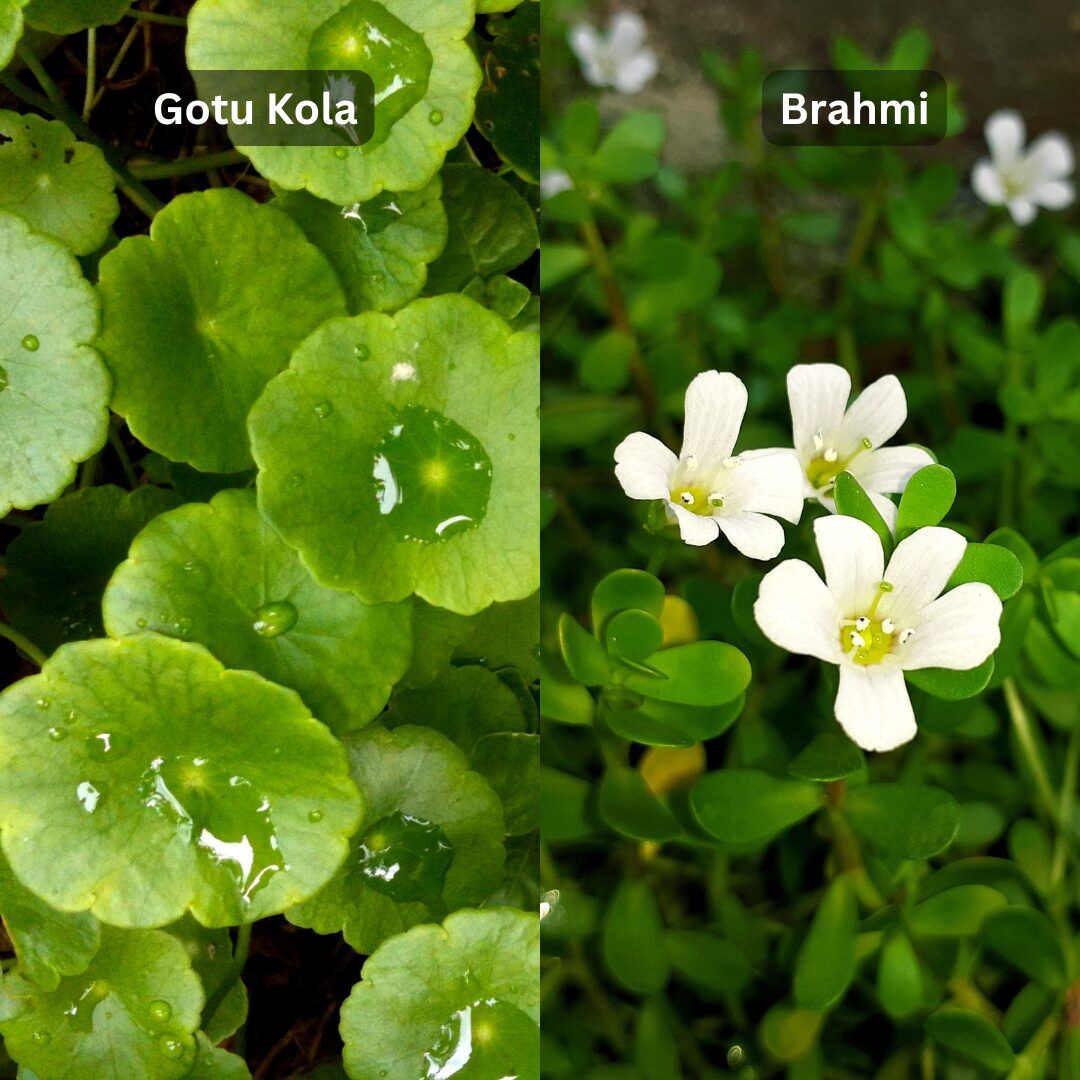
Anyone hunting the plant in the field will nearly miss it. Gotu kola is a modest creeper of the parsley family, threading itself along ditches, paddy-field margins and riverbanks throughout the warm, wet parts of Asia, and rooting afresh at every node it touches down. The leaves are its signature: round or kidney-shaped, gently scalloped at the edge, held up singly on slender stalks like a procession of small green fans. The flowers, by contrast, are almost apologetic — tiny, pinkish, tucked beneath the foliage where hardly anyone looks.
The Sinhala name is honest about all this. Gotu kola means, more or less, the cone-shaped leaf — a plain kitchen name for a plant that has always been part of the Sri Lankan kitchen, where the shredded leaf goes into the everyday village salad to this day. The Sanskrit name is better still: mandukaparni, the frog-leaved one — the plant of the wet margins where the frogs sit. Old names like these are field notes; they record where the plant grows and what it looks like before any herbal says a word about virtue.
Two herbs, one name
Here the historian must slow down, because India's naming has laid a famous trap. Across much of northern India, the name brahmi was — and still is — given to gotu kola itself; in the south and in the classical Ayurvedic literature, brahmi means a different plant altogether, the marsh herb Bacopa monnieri. Two distinct plants, from two different families, wearing one exalted name between them. The confusion runs right through the old texts and their commentaries, and scholars of the tradition have argued for centuries about which plant a given verse intends.
What the tangle really records is a shared reputation. Both are low, creeping herbs of wet ground; both were classed by the tradition as herbs of the mind; and both were held in enough esteem that each region wanted the great name for its own local plant. When a culture fights over which herb deserves to be called after the creator god, both herbs have already won.
The herb named for the creator
Brahmi — Bacopa monnieri, to give the southern claimant its botanical passport — carries the boldest name in the whole Indian pharmacopoeia: it is called after Brahma, the creator. Some lineages reached instead for Saraswati, the goddess of learning and eloquence, and gave the plant her name — which amounts to the same compliment paid in a different register.
The plant itself is a small succulent creeper of mudbanks and marsh edges, with fleshy little leaves and pale five-petalled flowers, growing in warm wetlands across much of the world. English botany, unimpressed by theology, calls it water hyssop.
The classical texts classed it among the medhya rasayanas, the rejuvenators of the intellect, and it was given above all to students of the scriptures. To understand why, one must remember what memory meant in Vedic India: the sacred verses were not primarily written but carried — chanted, checked, and handed from teacher to student across generations, with elaborate systems of recitation designed to catch a single altered syllable. In a civilisation where the scriptures lived in human memory, the plants believed to strengthen memory held a place of real honour. It was believed that Brahmi sharpened recall and quieted the restless stream of thought, so that what was learned would stay.
What the Ayurvedic classics believed
The great compendia of Ayurveda — the Charaka Samhita foremost among them, compiled and re-edited across the early centuries of the common era — set out the doctrine formally. Charaka names a short list of medhya rasayanas, the herbs of the intellect, and mandukaparni — gotu kola — stands in it, in the company of a handful of other revered plants. The commentators explain the term simply enough: medha is the retaining, comprehending power of the mind, and a medhya herb was one believed to feed it.
The claims the old physicians made were, by their own lights, generous: they held that such herbs supported long life, restored the wearied faculties, and gave the student strength for the discipline of study. We report the belief as belief. What can be said with plain historical confidence is that these two leaves kept their standing in the tradition for something approaching two thousand years — an endurance of reputation that very few plants in any pharmacopoeia can match.
The folklore of the long-lived leaf
Around the sober texts, the stories grew tall. The most famous belongs to China, where gotu kola also found a home in the recorded materia medica: the tale of Li Ching-Yuen, an herbalist of Sichuan who was said — by newspaper legend in the early twentieth century — to have lived through more than two centuries, sustained by a diet in which gotu kola figured prominently. The story is a tall tale and was doubted even in its own day; but tall tales are votes, and this one records exactly what the plant's neighbours believed of it — that this was the leaf of the long-lived.
The Sinhalese proverb, the grazing elephants, the Sichuan patriarch: three cultures, one conviction, arrived at separately. Folk traditions rarely agree so neatly, and when they do, the historian at least raises an eyebrow and writes it down.
Two temperaments, one Work
The pairing of the two herbs is old common sense. The traditions held Gotu Kola to build the mind's endurance slowly, the way a pilgrimage builds the legs, and Brahmi to calm and clarify — to still the surface so the depths could be read. A scholar needs both the library and the quiet reading room; the old physicians of India, who trained scholars by the temple-full, prescribed accordingly.
In the hermetic assignment both leaves answer to Mercury — patron of scribes, students, messengers and translators, the planet of the word itself. The correspondence almost writes itself: here are two herbs that entire cultures dedicated to the keeping of words, one named for the god who spoke the world into being, the other fed to the students who kept the speech alive. Mercury rules a crowded house, but few of his herbs earned the tenancy so literally.
Brahmi, the Herb of Grace
English herb-lore, ever practical, gave Bacopa a name of its own: the herb of grace. It is a title with a double sound — the plain botanical grace of a small marsh creeper with pale five-petalled flowers, and the older, gentler sense of grace as a blessing conferred. On the plant it sat easily. Here was a herb the Indian tradition had already crowned with divine names, and the English tongue, reaching for its own word, landed on grace as though by instinct. The two namings, a world apart, paid the same compliment in different coin: one culture heard the creator in it, the other heard benediction. Old folk names are rarely accidents, and when a modest water-plant collects titles like these from strangers who never compared notes, the reputation that gathered them is worth pausing over.
Brahmi and the Name of Brahman
The name carries further than Brahma the creator alone. Brahmi is the feminine of brahman — and in the Vedic mind Brahman was the vast word for universal consciousness, the ground of being, the divine intelligence underlying all things. To name a plant brahmi was therefore to file it not merely under a god but under mind itself, the cosmic and the human alike. Small wonder the tradition set it beside Saraswati, goddess of learning, speech and the arts, and gave students of the scriptures her leaf to keep at their studies. The old grammarians who prized clear speech, and the reciters who guarded the sacred verses syllable by syllable, would have felt the aptness: a plant named for consciousness, entrusted to those whose whole vocation was the keeping and the carrying of the word.
Gotu Kola and the Memory of Elephants
The Sri Lankan countryside kept a charming account of why gotu kola mattered. The elephant, the villagers observed, was the beast that never forgot — long of life and famously long of memory — and the elephant, they noted, was fond of grazing the little round leaf. From this the folk logic drew its conclusion in the plainest way: the leaf that fed the memory of elephants was a leaf worth a scholar's while. India told a neighbouring tale, naming the creeper the "tiger herb," for wounded tigers were said to seek it out and roll in its low green mats to mend themselves. Both stories are folklore rather than record, and they should be enjoyed as folklore — but they show what the plant's neighbours believed of it, and to which beasts of the field they reckoned it kin: the enduring, the long-memoried, the fierce.
The Scholar's Herbs and the Sphere of Mercury
In the planetary scheme the old herbalists inherited, the two scholars' leaves answered to Mercury — patron of scribes, students, messengers and translators, the quick planet of the word and the working mind. The Ayurvedic tradition had already classed them among its medhya rasayanas, the rejuvenators of the intellect, and set them in the hands of those who kept the scriptures alive by heart; the Western hermetic reading, arriving from another world entirely, filed them under the very same sphere. Two traditions, wholly unacquainted, agreed on the assignment — which is the surest sign the plants had earned it. This was the frame the alchemists brought when they set such herbs in glass, drawing out their virtue in the planetary key. To see how that art proceeded, read What is a spagyric tincture?.
Gotu Kola with Brahmi is kept in our apothecary as a spagyric tincture in the Mercurial register — the two scholars' leaves, married in one vessel. You can see it here. As with everything on our shelves, it is a collector's piece: the history above belongs to the traditions of the past, and we sell no remedy.