
This article belongs to our Herbarium — a library of what past traditions believed about the great herbs of the Work. It records history, not advice: we describe what herbalists of other centuries did and thought, and we make no claims of our own. Nothing here is a guide to use.
The goddess's garden
The Greeks knew marjoram's family as origanon — read by the old etymologists as "joy of the mountain" — and legend gave the sweet marjoram to Aphrodite herself: the goddess was said to have raised the herb with her own hands, and its fragrance to be the trace her touch left behind. It was a plant of gladness from the beginning of its recorded life.
The ancients told a second story about its origin, this one from Cyprus, Aphrodite's own island. Amaracus, a young servant of the Cypriot royal house, was carrying a precious vessel of perfume when he stumbled and let it fall; overcome with grief, the story goes, he fainted away, and the gods in their mercy transformed him into the sweet-scented herb that afterward bore his name. Amaracus remained one of the plant's names throughout antiquity, and the most celebrated perfumed unguent of the classical world, the amaracinum, was compounded from it. A boy who became a fragrance, a goddess who left her scent on a leaf — the Greek imagination kept circling the same fact: this plant smells like happiness.
What marjoram is and where it grows
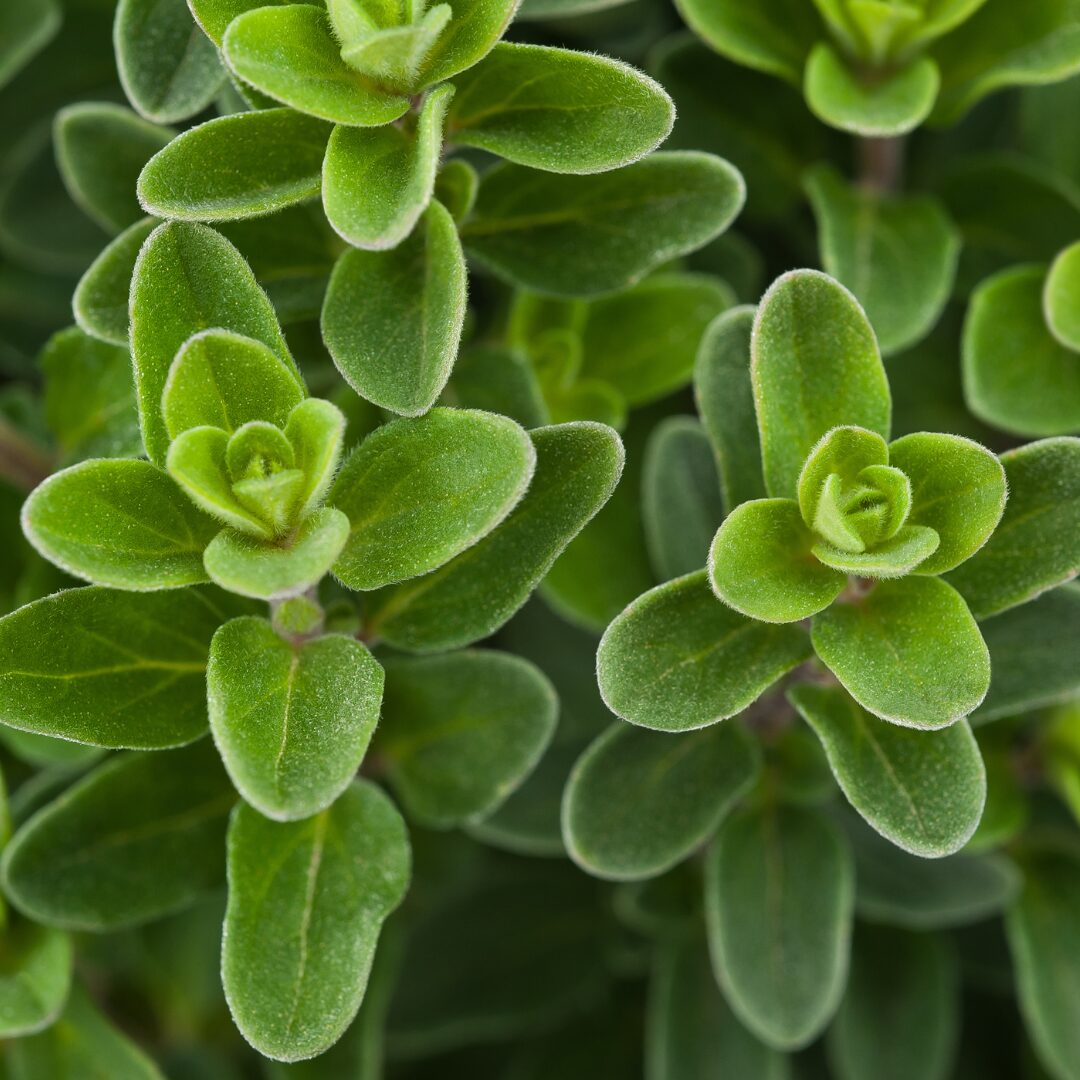
Origanum majorana, the sweet or knotted marjoram, is a small bushy plant of the mint family, native to Cyprus, Asia Minor and the eastern Mediterranean. Its leaves are small, oval and gray-green, soft with a fine down; its flowers are held in tight, rounded clusters like little knots along the stem — the "knots" that gave the old gardeners their name for it, knotted marjoram. The whole plant carries the scent that made its fortune: warmer and sweeter than its wilder cousin oregano, a spiced softness with the sun still in it.
In the warm lands of its birth it lives as a perennial; in the gardens of northern Europe, which adopted it with enthusiasm, it was tender and had to be raised each year afresh — a small annual labor the north was evidently glad to pay, for by the sixteenth century no proper English garden was without it. It is a plant of dry slopes and full light, a mountain herb by temperament as well as by name.
The names it carried
Few small herbs have worn so many names. The Greeks knew it as sampsuchon and as amarakos; the Romans latinized both. The name it answers to now, majorana, appears in the Latin of the Middle Ages, and the scholars have never fully agreed on where it came from — some derived it from major, "greater," as though the plant were the elder of its tribe, while others suspected an older, borrowed word whose origin is simply lost. The English tongue softened it to marjoram, and the gardeners added their own plain poetry: sweet marjoram for the scent, knotted marjoram for the clustered flower buds. Meanwhile the family name origanum kept the mountain in the story — oros, mountain, and ganos, brightness or joy, as the old etymologists read it. A word history, like the plant's mythology, that keeps arriving at the same place: brightness, sweetness, joy.
Crowns and graves
In Greece and Rome, bridal couples were crowned with wreaths of marjoram — the plant of love's goddess blessing love's contract. And the same herb attended the other end of life with equal tenderness: where marjoram grew upon a grave, the old folk said, the departed rested in happiness. Few plants held both offices at once, standing garlanded at the wedding feast and keeping quiet watch in the churchyard. The double duty is worth pausing over. To the classical mind these were not opposite assignments but one and the same: marjoram marked the places where love had come out well.
The strewing centuries
Through the medieval and Tudor centuries marjoram remained a herb of joyful houses. It was one of the great strewing herbs, scattered over the floors of halls and chambers so that footsteps released its scent, and it filled the sweet bags and washing waters of the Elizabethan housewife; the herb was rubbed into furniture to perfume the wood. Before the hop conquered English brewing, marjoram was among the herbs used to scent and preserve ale.
Shakespeare, who misses very little of the English garden, gives marjoram its due. Perdita hands out "hot lavender, mints, savory, marjoram" among the flowers of The Winter's Tale, and in All's Well That Ends Well the herb stands as a byword for excellence — the sweet marjoram of the salad. When a plant becomes a compliment, its reputation needs no further witness.
What the old herbals believed
The written tradition begins with Dioscorides, the first-century physician whose De Materia Medica remained the authority of the Western world for fifteen hundred years; he recorded the herb under its old names and the perfumers' use of it. The herbalists of the Renaissance received the plant with the warmth it seemed to ask for. Gerard, writing at the close of the sixteenth century, placed sweet marjoram among the comforting herbs and commended it, in his memorable phrase, for those "given to over-much sighing" — the old herbals held that it was a warming plant, a comforter of the head and heart, a herb for grief that had settled in and gone stale. Nicholas Culpeper, assigning every plant its planet as his system required, set marjoram under Mercury, and counted it among the warming herbs of the head. The recurring conviction, across these sources, was movement: it was believed to warm what had grown cold, to loosen what had stiffened, and to set what had grown stagnant gently moving again.
Dreaming of the beloved
Marjoram kept one more office in the folk record: it was a herb of love divination. English folk custom held that a maiden who honored St. Luke's Day with the proper charm — marjoram among its herbs, with thyme and other plants of the garden — would see her future husband in her dreams. The custom is recorded in the folklore collections with regional variations, but marjoram's place in it is constant, and entirely in character: the herb of Aphrodite, asked politely, might be persuaded to show love's face a little ahead of time. In the language of flowers that the nineteenth century codified, marjoram stood for blushes and for joy — the last dialect of a very old association.
Mercury's messenger
For all its Venusian biography, the hermetic tradition our apothecary follows sets marjoram under Mercury — the planet of movement, roads and quick spirits, and the assignment the old astrologer-herbalists themselves made. It fits the plant's temperament as the tradition described it: marjoram is a mover of what has settled, a loosener, the light-footed guest who gets a stiff room talking. Venus may have raised the herb, but Mercury taught it to travel — from a Cypriot hillside into the wreaths of Roman weddings, the floors of Tudor halls, the sweet bags of the still-room, the pages of Shakespeare. The signature is the setting-out: the traveler's herb of glad beginnings.
The Magical Properties of Marjoram
The magical properties folk custom lent to marjoram were, almost without exception, offices of love and gladness. A sprig was said to be carried on the person to draw a sweet and compatible affection, and the herb had a long place in the old love-potions and love-charms of the European record. It was woven, too, into the garlands of the wedding feast as a token of love and honour. And where sorrow had gathered, marjoram was held to be a banisher of it: the medieval writers gave it a settled reputation for turning back melancholy and lifting a heavy spirit — the herb of gladness doing, in the folk imagination, exactly what its name promised. None of this was ever counsel; it is the lore that clung to a plant the old world simply associated with happiness, carried in the pocket the way one carries a hope.
Joy of the Mountain: What Marjoram's Name Means
The family name origanum is the one that carries the poetry, and the old etymologists read it as a compound of two Greek words — oros, mountain, and ganos, brightness or joy — giving the beloved gloss "joy of the mountain." It is a reading worth keeping, for it matches the plant exactly: a sun-loving herb of dry slopes and high light, gladness rooted on a hillside. Honesty asks a footnote, though. Not every scholar has been content with "joy"; some render ganos nearer to "brightness," "sheen" or "ornament," so that the phrase tips toward "the ornament of the mountain" — the same hill, a slightly different jewel. Either way the word keeps arriving at the same place: height, light, and something bright enough to be worth a name.
Aphrodite's Herb: Marjoram in Greek Myth
In the Greek imagination marjoram belonged to Aphrodite. The goddess of love, the old story said, raised the sweet marjoram with her own hands, and the fragrance the herb carried was the very trace her touch had left upon the leaf — a plant that smelled of her favour. Under that patronage it became the herb of the marriage rite: bridal couples in Greece and Rome were crowned with marjoram wreaths, the goddess's own plant blessing love's contract. The same garlands attended the grave, and where marjoram was found growing over a tomb the folk read it as a sign that the departed rested in happiness, love's herb promising a glad afterlife. Wedding and funeral, one leaf: to the classical mind, marjoram simply marked the places where love had come out well.
Marjoram and the Planet Mercury
Its myth is Venusian, and rightly told as myth and love-lore — but the planet the house assigns it is Mercury, the same signature the old astrologer-herbalists set upon it. In our hermetic reckoning that assignment reads through the element of air: Mercury the swift, the messenger, the planet of communication, roads, and the quick-moving mind. It suits the plant the tradition described — a light-footed traveller, a loosener of what has stalled, the guest who gets a still room talking. Where Venus raised marjoram, Mercury sent it out walking, carrying its scent from a Cypriot hillside into wreaths, halls, still-rooms and the pages of poets. Read the fuller method behind such a working in What is a spagyric tincture?. Marjoram's is the Mercurial signature of the glad beginning: air, motion, and the setting-out.
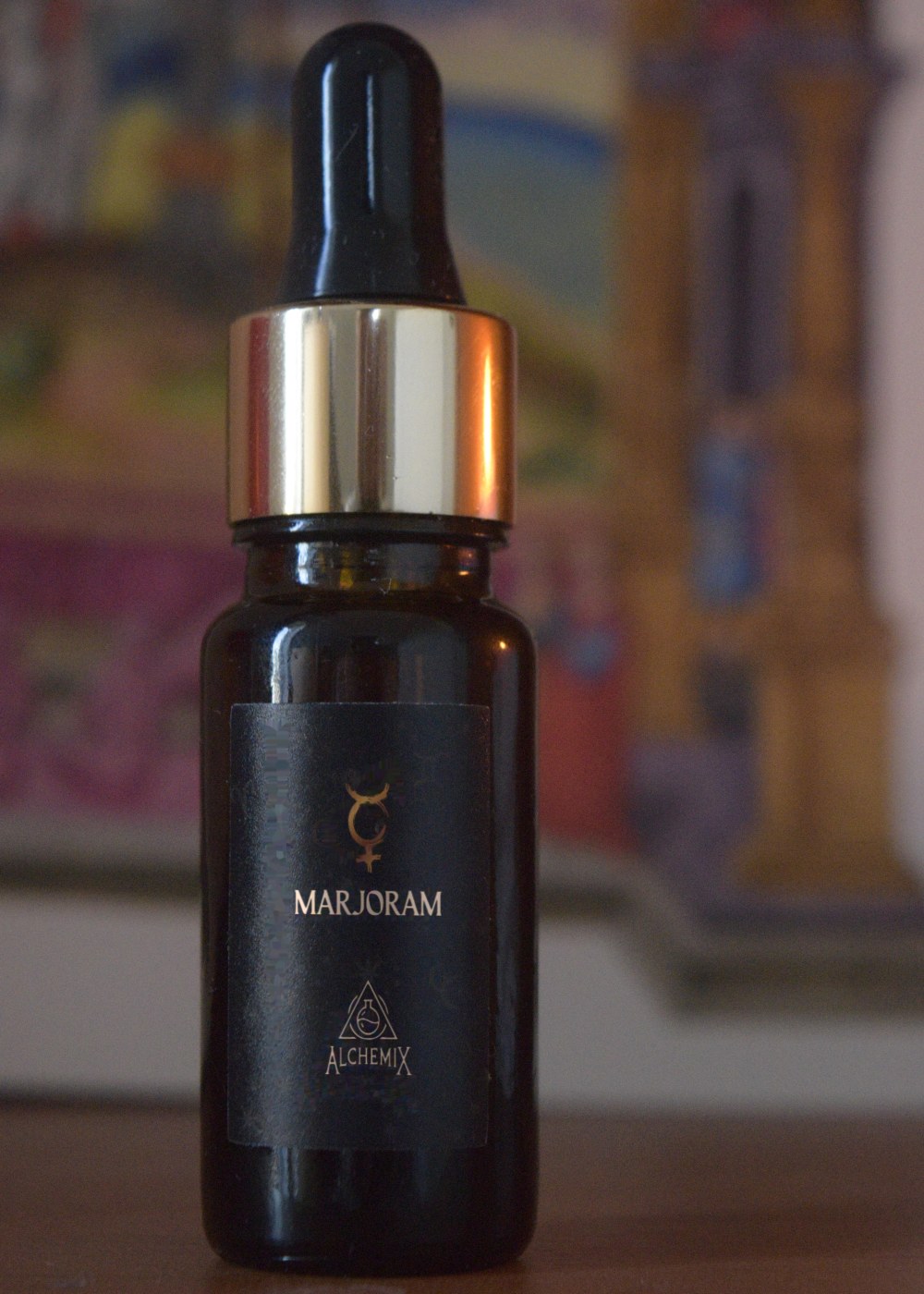
Marjoram is kept in our apothecary as a full spagyric tincture in the Mercurial register — the herb's own calcined salt returned to the vessel. You can see it here. As with everything on our shelves, it is a collector's piece: the history above belongs to the traditions of the past, and we sell no remedy.